Psychosis: What is it?
Deepen your understanding of psychotic states and learn when spiritual experiences overlap with or differ from psychotic episodes.


Applies to Level 2 Certification
This course is part of the Level 2 Spiritual Emergence Coach® Certification. You can take this course individually or as part of the complete certification bundle. Upon completion, this course will count toward your Level 2 certification requirements.
About this course
This course is designed for anyone who wants a broader, more humane, and more nuanced understanding of psychosis. The course includes an overview of trauma-based approaches, further exploration of the concept of spiritual emergency, an optional quiz to affirm learning, and a free book and video by Anne Cooke, PhD.
What do we really mean when we use terms like psychosis or psychotic states? In recent years, these labels have increasingly been questioned, challenged, and redefined. This course offers a thoughtful introduction to those changing perspectives, helping you better understand how extreme states of consciousness have traditionally been viewed and how more progressive approaches are opening up new possibilities for diagnosis and care.
Through a video presentation and a few short articles, you will explore different ways of understanding what is often grouped together under the label of psychosis. Rather than assuming these experiences are always signs of disease, the course introduces perspectives from seasoned professionals who draw on decades of clinical and therapeutic experience.
You will examine how the dominant biomedical model shapes diagnosis and treatment, and why many clinicians and researchers believe that model is often too narrow. The course also looks at how so-called psychotic states can sometimes reflect understandable responses to trauma, and how labeling them only as mental illness can contribute to unnecessary stigma, fear, and the social rejection of people in distress. At the same time, it introduces the idea that some extreme states carry the potential for insight, growth, and positive transformation when they are understood and appropriately supported.
Learning Objectives

Describe different perspectives on what is commonly labeled as psychosis
Explain how the dominant biomedical model has shaped the understanding of extreme states
Recognize how some so-called psychotic states may be connected to trauma
Identify how labeling extreme states only as mental illness can increase stigma and misunderstanding
Discuss alternative approaches to engaging, coping with, and supporting extreme states beyond medication alone
Explain how some extreme states may hold potential for healing, meaning, and positive transformation
Syllabus
Understanding Psychosis

 Overview: Defining “psychosis”
- Jim van Os, MD, in middle photo below, on normalizing psychosis
- Take the quiz – contemplate symptoms
- Re-evaluate the dominant, biomedical view
- Consider trauma-based approaches
- Learn how the concept of “spiritual emergency” can be of value
- Free book and video by Anne Cooke, PhD.
Your Instructors

Jim van Os, MD
Jim van Os is Professor and Chairman of the Department of Psychiatry and Psychology at Maastricht University Medical Centre, Maastricht, The Netherlands, and Visiting Professor of Psychiatric Epidemiology at the Institute of Psychiatry, London, UK. He trained in Psychiatry in Casablanca (Morocco), Bordeaux (France) and finally at the Institute of Psychiatry and the Maudsley/Bethlem Royal Hospital in London (UK) and after his clinical training was awarded a three-year UK Medical Research Council Training Fellowship in Clinical Epidemiology at the London School of Hygiene and Tropical Medicine.
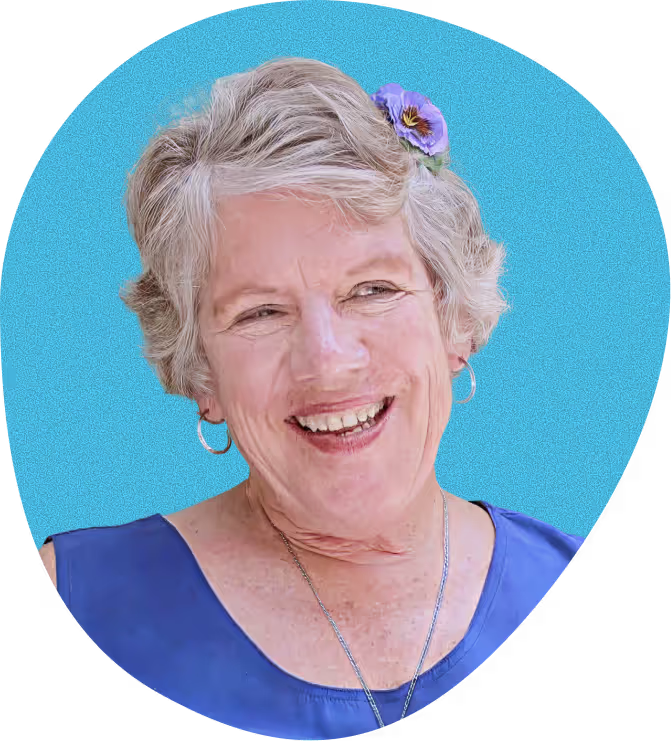
Emma Bragdom, PhD
Dr. Emma Bragdon is a pioneer in body–mind–spirit wellness with 50 years of experience in integrative approaches to mental health, healing, and human development. She has written seven books, co-produced two documentary films, and has taught experiential learning for adults since 1985. Emma volunteered with the Spiritual Emergence Network (SEN) for seven years, editing their journal and coordinating conferences at Esalen Institute with founders Stanislav and Christina Grof. Her PhD dissertation, "How to Support Someone in Spiritual Emergency," launched a lifelong specialization in this field. From 2001–2012, she conducted field research at Spiritist Community Centers and Psychiatric Hospitals in Brazil, studying their 120-year-old model of integrative care. Since 2012, she has served as "ambassador" to non-Brazilians for the Spiritist Psychiatric Hospital in Goiânia, Brazil, facilitating seminars for health professionals worldwide.

Ann Cooke, PhD
Anne is Clinical Director of the Doctoral Programme in Clinical Psychology at Canterbury Christ Church University. For many years she worked as a consultant clinical psychologist in the NHS. Anne was British Psychological Society Practitioner of the Year in 2017, and is renowned for her work furthering psychological approaches to psychosis.
About Continuing Education Credits
For licensed health professionals seeking CE credits for license renewal

CE Provider Information
CE credits are provided by Westbrook University, an APA-approved continuing education provider for healthcare professionals.
Level 2 Certification Courses
Explore all courses in the Level 2 certification pathway. Advance your expertise with specialized training in clinical assessment and ethical practice.
Residential Treatment & Collaborative Care
Explore how integrative residential treatment centers provide holistic care for individuals experiencing mental health crises and spiritual emergence.

Inner Ethics When Working with Non-Ordinary States
Develop ethical awareness and establish healthy boundaries when supporting clients through psychedelic experiences and non-ordinary states of consciousness.
How to Differentiate Spiritual Crisis from Pathology
Master the critical skills needed to distinguish between spiritual emergence and mental health conditions requiring different therapeutic approaches.
Screening for Spiritual Emergence
Receive a validated screening tool designed specifically for identifying spiritual emergence in clinical settings and private practice.
Psychosis: What is it?
Deepen your understanding of psychotic states and learn when spiritual experiences overlap with or differ from psychotic episodes.