


What Is a Spiritual Awakening?
In plain language, a spiritual awakening is an experience in which a person encounters a positive, vast reality beyond their usual sense of self, yet one they also experience themselves as part of. This encounter has a transformative effect, expanding their sense of identity and deepening their connection to what feels most true and real. Many people describe a spiritual awakening as the moment they realize through direct experience that the ordinary mind is not the whole of who they are, and that a deeper Self is in relationship with something greater than themselves.
What it is not
A spiritual awakening does not involve persistent extreme states of anxiety or fear that diminish self-worth or lead a person to harm themselves or others. A genuine spiritual awakening does not inflate the ego. It softens ego rigidity and helps a person examine their beliefs with humility rather than strong ego defensiveness.
How many are in the process of awakening?
It’s hard to count the numbers because until very recently admitting to having spiritual experiences was perceived by others that you may be out of your mind, i.e., crazy. For several hundred years, our culture has believed that if you can’t measure something with the 5 senses, “it is unreal”. That left experiences of the 6th sense (e.g., intuition, telepathy, channeling, psychic perception, etc.) as being considered “unreal”. Recent surveys indicate that 45-60% of North Americans report deeply spiritual experiences that affect their lives (Sandilands & Ingram, 2024; Pew Research, 2023).
Why People Talk About “Awakening” So Differently
Religious frames vs. secular frames
For hundreds of years, people in the West have looked to religious institutions for a framework for our spiritual lives and a sense of communion with the Divine. Many people are now turning away from conventional religion and seeking meaningful guidance in more secular teachings that dovetail with indigenous or Eastern philosophies. In practice, many people move between religion and spirituality as part of a single spiritual journey, using what is helpful from both while learning to recognize what supports healing and transformation in daily life.
In my early 20s (in the late 1960s through the mid-1970s), I chose to learn directly from a Yurok Indian shaman named Harry Roberts, who met regularly with a small group of us interested in his wisdom. One of his favorite phrases was, “You gotta wake up and smell the coffee!” He wasn’t talking about breakfast. He meant: Wake up—everything you do has consequences. Pay attention.
For example, if we engage in sex without adequate protection, we may create a life that needs our care and attention for decades. Or, if we have an experience of oneness with nature—or with “All That Is”—our sense of who we are inevitably changes. That shift may inspire us to protect the natural world or transform our relationship with nature, God, or the ultimate truth.
Embedded in Harry’s Indigenous philosophy was a strong emphasis on practicality and responsibility: defining one’s purpose and clarifying what truly matters. He taught methods for expanding consciousness—awakening beyond ego—without the use of plant medicines or drugs.
Conventional religious institutions, by contrast, have not typically offered techniques for awakening experiences. Instead, they provide belief systems, community, and rituals marking life passages such as birth, marriage, and death—important bonding experiences, to be sure. One notable exception is Sanatana Dharma, the “eternal science of Truth” originating in India and commonly referred to as the essence of Hinduism. Rather than emphasizing dogma, it offers practical methods for directly perceiving spiritual truth and moving toward awakening (Yogananda, 2020).
In a nutshell, religion offers clear moral structure, while spirituality offers a direct path to connecting to something greater than ourselves. Together, they can support stable spiritual practices rather than abstract beliefs alone. This integrated approach to religion and contemplative discipline often helps people realize that awakening can be practical, relational, and grounded in their daily lives.
A secular framing of awakening has become increasingly confusing. The term “woke” originally referred to awareness of racial and social injustice, but it has since evolved into a politically charged and often pejorative label. “Awakening,” however, remains in use—particularly among those influenced by Eastern philosophies, Indigenous traditions, psychedelic and plant-medicine exploration, and insights into the nature of consciousness from modern physics. From these perspectives, we learn that all is fundamentally energy, and that while the five senses are useful tools for navigating consensus reality, they are also inherently limited.
Many people who reach out to IMHU describe intense spiritual awakening experiences—and a familiar frustration: they can’t find a framework that makes sense of them without pathologizing it or forcing it into a rigid belief system. If that’s you, you may find these starting points useful: [Spiritual Awakening overview], [Spiritual Emergency overview], [SE Coaches Directory]. For clinicians and other helpers who want a stronger foundation, we also have the [Practicum] and [Spiritual Emergence Coach® training].
Many people who reach out to IMHU describe intense spiritual awakening experiences and a familiar frustration: they can’t find a framework that makes sense of it without pathologizing it or forcing it into a rigid belief system. If that’s you, you may find these starting points useful:
- How to Differentiate Spiritual Crisis from Pathology
- Am I Having a Spiritual Emergency?
- Spiritual Emergency: What is it?
- Psychosis: What is it?
Psychological frames vs. mystical frames
Most of us lack a shared language for experiences that transcend the ego. In fact, the frameworks taught to medical professionals and psychologists often explicitly link changes in one’s sense of reality to mental disorders. If someone feels temporarily disoriented after an experience of oneness—perhaps losing track of time or personal identity—they may be labeled psychotic and prescribed antipsychotic medication to suppress what are perceived as symptoms of a biological disorder. At IMHU, we often hear stories of individuals who have felt their spiritual experiences were never respected by conventional psychiatrists and psychologists.
Conventional healthcare training rarely includes education about the broader arc of human evolution and consciousness development. We learn about human development—from early childhood, dominated by physical growth and restless energy; to adolescence, shaped by emotion and desire; to adulthood, guided by reason and responsibility; and finally, a stage oriented toward wisdom. What is largely missing is any discussion of the language or lived experience of expanding consciousness, including experiences often described as spiritual awakening.

When this language is missing, people in a so-called “dark night of the soul” can be misread, and psycho-spiritual experiences may be treated as pathology before careful discernment is applied. In these states, a person may appear fragmented, yet the deeper self may be reorganizing around a healthier center of awareness.
As a result, individuals who have had awakening experiences may find themselves unsupported or misunderstood, while healthcare providers are left with significant knowledge gaps regarding diagnosis, prognosis, and the integration of positive human potential.
Why Definitions Matter for Mental Health and Integration
Without an understanding of the territory associated with expanding consciousness, misdiagnosis and inappropriate treatment can occur. Individuals seeking help to integrate their experiences may instead receive medications that blunt or suppress their expanded states and the stigma of being called “mentally ill”. A free short course at IMHU illustrates this with “Stories of Awakenings”.
Ideally, healthcare providers would understand that temporary disorientation can occur, and that awakening experiences—when properly supported— lead to increased peace, life satisfaction, meaningful relationships, and a stronger sense of purpose rooted in the deepest Self rather than the ego. IMHU’s teaching includes a broad survey of what awakening experiences can look and feel like—this is profoundly grounding for people with lived experience, their concerned loved ones, and healthcare providers.
Clear definitions also help people realize that spiritual awakening can be disruptive without being meaningless, and that a dark night may be one phase in a longer spiritual journey toward integration. They also reduce clinical misinterpretation by distinguishing spiritual emergency risk from the spiritually-transformative experience, and by tracking whether beliefs become more flexible, compassionate, and reality-based over time.
Common Myths About Spiritual Awakening (and What’s More True)
Myth: “An awakening means you’ll feel blissful all the time.”
My first awakening experiences occurred before I was ten years old, during two near-death experiences. At the very beginning, there was intense fear, as the finality of death became real. That fear quickly dissolved into an immersion in complete love, joy, and beauty. Time disappeared. The experience felt like the most real reality I had ever known.
When I returned, however, I had no language for what had happened and no one to talk to. I felt alone and estranged from ordinary social life. Had no one else experienced this? I wondered. I began to feel like an outsider, with a need to shape myself to fit what others valued.
Despite this, I retained an inner sense of what felt most real to me. When I was introduced to meditation at age 18, I was ecstatic. Here was a way to enter that reality I most treasured without dying. I have carried that insight with me ever since and made meditation an important part of my life.
Still, awakening did not spare me from life’s challenges: loss of relationships, the deaths of my parents, and financial instability. Awakening brought bliss—but also loneliness, disorientation, and the search for community and language that could hold these experiences. My Co-Executive Director at IMHU, Andy Johns, attests to the same reality of spiritual awakening. Sometimes, it brings a profound sense of inner peace and effortless living. Other times, it is the catalyst for disorientation, lostness, and a direct confrontation with challenging waves of negative emotions.
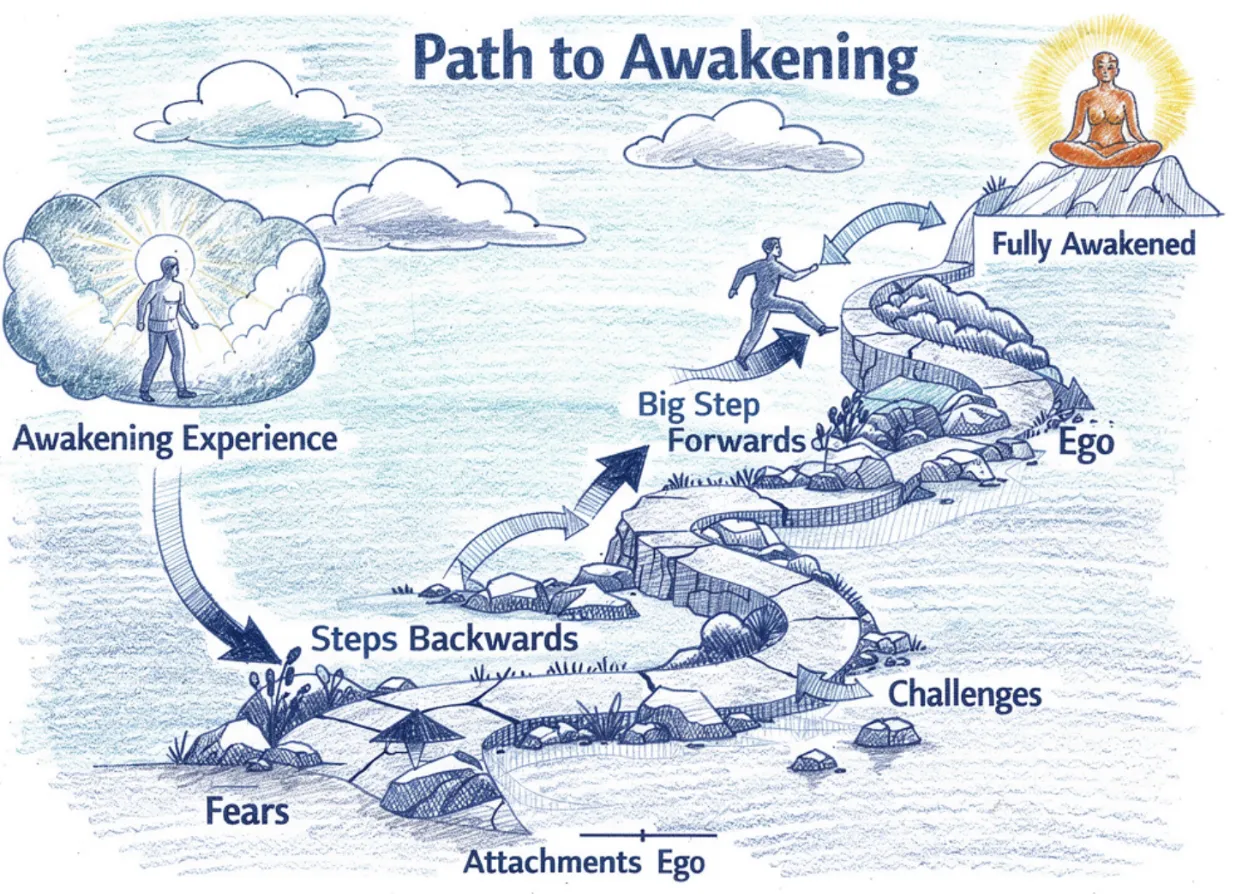
It is helpful to think of awakening as a process that may unfold over a long time, maybe many lifetimes. It often begins with a powerful experience—such as a near-death experience—that sets one on the path. From there, progress is rarely linear. We may take a great step forward through meditation, then stumble backward for a time because of anger, addiction, or disappointments in relationships. Epiphanies of joy can be followed by periods of doubt or hopelessness that must be faced and integrated.

In other words, one profound opening does not instantly dissolve ego patterns; many people become more awake in stages, with alternating clarity and contraction. A spiritual awakening can reveal expanded states of consciousness in unmistakable ways, yet integration still asks for discipline and time.
Myth: “If you’re anxious or depressed, you’re doing it wrong.”
Suppose you meditate daily with the intention of awakening more fully, yet anxiety or depression emerges. Actually, this indicates an increasing awareness of past experiences and emotional responses that were previously pushed into the unconscious.
These feelings are invitations to bring what was hidden into conscious awareness, to acknowledge and integrate the experiences, a way to deeper peace and authenticity, being real. Resistance to painful memories tends to intensify suffering, often through recurring negative thought patterns or chronic pain. When anxiety or depression persist, psychotherapy can be a valuable companion to spiritual practice. It certainly has been for me! Awakening is not just about spiritual experiences; it’s about being more authentic and more present.
Often, this is where people realize that spiritual practices and clinical support can work together: one helps calm and focus the mind, the other helps integrate trauma and update old beliefs. Many people describe this stage as living more spiritually: less avoidance, more emotional truth, and more responsibility for how ego defenses shape relationships.
Myth: “Awakened people are beyond ego.”
Those who are fully awakened do not identify as the ego, but that does not mean ego disappears, i.e., you are empty of ego. Even enlightened beings must relate to the body to care for themselves in the world by maintaining wholesome habits regarding food, rest and exercise.
In our present culture, very few people reach full awakening. Those who do are typically devoted to helping others awaken, without seeking wealth, status, or recognition. They have no need to manipulate or exploit others for personal gain.
Mature enlightenment places ego in the right relationship, so the self can function responsibly without mistaking social identity for the whole Self. Stable enlightenment is not the theater of ego death; it is expressed through conduct with clarity, humility, and care.
Myth: “Awakening makes you morally superior.”
Those who are fully awakened tend to act morally, not because they see themselves as superior or because they are following a scripted dogma. Moral behavior arises naturally from deep communion with All That Is.
The awakening process often demands moral courage. In my own life, I once learned a secret about a highly influential person who was harming others. I spoke out to his inner circle in order to find help for this man’s sexual addiction. I was then threatened with death if I revealed the secret to others. I wanted to protect people—and I also wanted to live. I survived. He is now in prison. The lessons I learned were profound.
Unadulterated spirituality tends to reduce moral grandstanding: you question illusion, test your beliefs in real life, and stay accountable across communities with different relationships to religion and spirituality. The soul matures through responsibility, not expressing superiority, and that is true whether a person speaks in secular language or religion-infused language.
Myth: “One big experience equals permanent transformation.”
A single awakening experience can inspire the desire to awaken more fully, but it does not guarantee permanent transformation. As Zen master Suzuki Roshi once said, “Enlightenment, once achieved, is something you must choose in each moment of your life.” I observed in him an extraordinary peace, paired with a disciplined and demanding daily life dedicated to helping others in their awakening. That is why spiritual awakening is better understood as a sustained spiritual journey, not a one-time event. Across a long spiritual journey, you repeatedly realize that insight must be embodied through our actions and relationships.
Truth: Awakening is uneven, embodied, and integrated over time
We live in a world of duality. No matter where we are on the path, challenges persist. Awakening is not merely intellectual understanding—it involves every cell of the body, every layer of being: body, mind, and soul. Nothing is left out. Over time, awakening becomes less performative and more embodied. There is less reactivity to the eventual challenges of daily life, clearer awareness, and a quieter mind despite the challenges we face. This is where spiritual awakening becomes lived ethics, as we integrate our expanded consciousness over time.