



The Promise of Awakening
At our core we are all seeking more happiness and peace. Many look to a spiritual or religious path—or psychedelics and plant medicines—to find it. Awakening has been described by religious texts and spiritual philosophies as both beautiful and liberating. Many who turn to plant medicines and psychedelics will report ecstatic experiences that free them from chronic physical or mental pain and stimulate creativity.
Awakening Can Bring:
- Greater inner peace and less stress and physical tension
- Deeper connection with oneself and others
- Increased self-acceptance and less judgment of oneself and others
- Greater self-awareness
Awakening May Also Ultimately Lead To:
- Experiencing pure awareness—simply being aware without judgement, with acceptance and gratitude
- A sense of oneness with all life, dropping one's sense of being separate
- Greater wisdom and compassion
- Living more fully in the present moment
- Less identification with the ego and more connection with the deeper self
When Awakening Feels Difficult
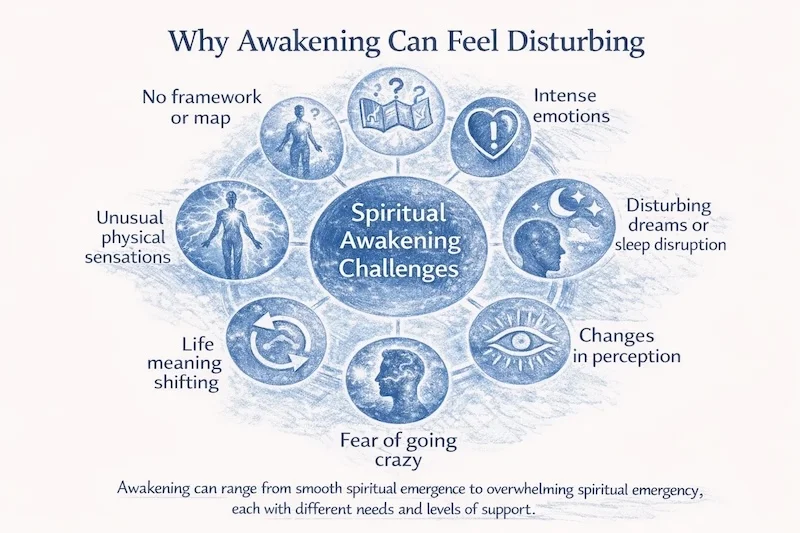
For many people, awakening to a more expanded sense of self and more refined perceptions can also bring confusion, emotional upheaval, and physical intensity. Psychiatrist Stanislav Grof and his wife Christina Grof created the term spiritual emergency in 1980 to describe this. They felt it was the mark of a potentially powerful inner transformation that temporarily may be disturbing—or even overwhelming.
Without a map or framework, unexpected non-ordinary experiences can feel frightening. Many people fall back on the only framework they know and think, "I must be crazy!" Few health care professionals are trained to recognize or support these experiences, and clergy and spiritual teachers often lack training in recognizing phenomena associated with awakening and the psychological processes that may co-occur.
Seven Ways Awakening Can Feel Disturbing
- No Map or Conceptual Framework — Without a framework, unexpected non-ordinary experiences can feel frightening, and others may mistakenly perceive the awakening as mental illness.
- No Guide — Few health care or spiritual professionals are trained to recognize and support psycho-spiritual transformation processes.
- Unusual Physical Sensations — Waves of energy, body vibrations, shaking, heat or pressure, and changes in sleep can be confusing and upsetting without context.
- Intense Emotions — Awakening may uncover unresolved psychological material from past trauma, manifesting as grief, fear, anger, or intrusive memories.
- Changes in Perception — Heightened sensitivity, vivid dreams, powerful symbols, or sensing dimensions beyond the five senses can feel frightening without context.
- Fear of "Going Crazy" — People may worry something is wrong and want to return to what feels normal. Friends, family, or clinicians may reinforce this fear.
- Loss of Old Meaning Structures — Career, relationships, identity, and life purpose may all shift profoundly, like a snake needing to shed a skin that is too tight.
Signs You May Be in a Spiritual Emergence Process
Possible signs include:
- Increased self-awareness
- Powerful emotional releases, sometimes without any story line or context
- Unusual inner experiences
- Questioning previous beliefs or life direction
- Searching for deeper meaning or purpose
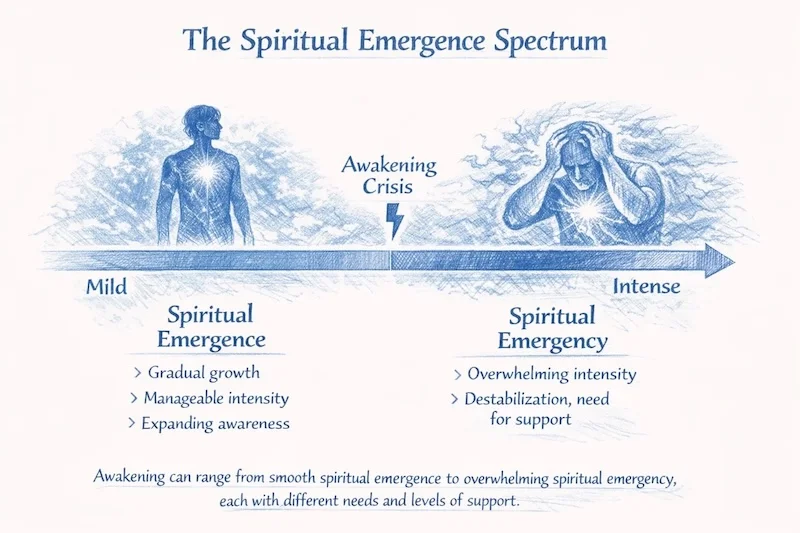
For some people, this unfolds gradually—what is called spiritual emergence. For others, it becomes intense and destabilizing, which is called spiritual emergency or spiritual crisis.
Why Support Matters—and Three Things That Can Help
When awakening becomes overwhelming, support makes a huge difference. Without guidance, people often feel isolated, frightened, and misunderstood. Hospitalization and psychiatric medication may prevent integration and even become a source of additional trauma. With appropriate support, the same process can become deeply transformative and ultimately lead to human flourishing.
Three Things That Can Help:
- Find a knowledgeable, skilled, and ethical guide — A trained practitioner who understands both psychological and spiritual processes can help you stay grounded. Supports include Spiritual Emergence Coaches® (see imhu.org/coaching/directory), therapists trained in transformative states, and integrative mental health practitioners.
- Join a supportive community — Support groups dedicated to spiritual awakening can normalize the experience and reduce isolation.
- Educate yourself — Books, lectures, videos, and courses on spiritual emergence can provide orientation and reassurance. IMHU's Knowledge Center and free resources at IMHU.org are a helpful place to start.