


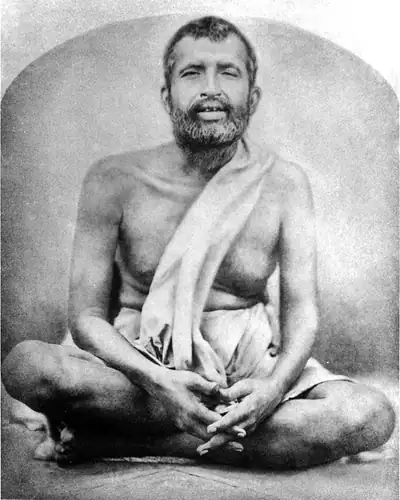
Who Is Ramakrishna
Sri Ramakrishna Paramahamsa (1836–1886) was an Indian Hindu mystic and priest of the Dakshineswar Kali Temple near Kolkata, whose life of intense spiritual practice and direct ecstatic experience became one of the most influential catalysts for the modern Hindu renaissance and the global spread of Vedanta philosophy. Born Gadadhar Chattopadhyay in rural Bengal to a poor Brahmin family, Ramakrishna displayed devotional intensity from childhood and was appointed priest at Dakshineswar in his late teens. There, he embarked on a series of sustained spiritual practices spanning multiple traditions—Shakta Tantra, Vaishnava devotion, Advaita Vedanta, Islam, and Christianity—and reported achieving direct mystical realization within each.
What makes Ramakrishna’s legacy distinctive is not just the range of his practice but the radical conclusion he drew from it: that all genuine spiritual paths lead to the same ultimate reality, and that direct experience—not doctrine, institution, or theological argument—is the true test of any teaching. His ecstatic states (which included periods of complete absorption in divine consciousness, sometimes lasting days) were witnessed and documented by a circle of educated Bengali intellectuals, several of whom became his disciples. The most prominent, Swami Vivekananda, carried Ramakrishna’s teachings to the West at the 1893 Parliament of the World’s Religions in Chicago and founded the Ramakrishna Order, which remains active in education, healthcare, and spiritual teaching worldwide. Ramakrishna’s conversations and teachings, recorded by his disciple Mahendranath Gupta in the Bengali classic Sri Sri Ramakrishna Kathamrita (translated as The Gospel of Sri Ramakrishna), offer one of the most detailed records of a mystic’s daily life, teaching style, and inner experience in any tradition.
Core Concepts
- The harmony of religions through direct experience
- Ramakrishna’s central teaching is that all authentic spiritual paths—Hindu, Muslim, Christian, and others—lead to the same divine reality, and that this is not a theoretical position but something he verified through sustained practice in each tradition. This experiential universalism—as opposed to merely intellectual tolerance—became the foundation of the Ramakrishna-Vivekananda movement and influenced later figures like Aldous Huxley, Huston Smith, and the perennial philosophy tradition. (Wikipedia)
- Bhakti (devotion) as the most accessible path
- While Ramakrishna practiced and endorsed multiple approaches—including the paths of knowledge (jnana), action (karma), and meditation (raja yoga)—he consistently taught that devotional love directed toward a personal form of God was the most natural and accessible path for most people, especially in the modern age. His own relationship with the Divine Mother Kali was intensely personal, emotional, and at times dramatically ecstatic.
- The danger of “lust and gold” (kama-kanchana)
- Ramakrishna frequently warned that attachment to sensual pleasure and wealth were the two primary obstacles to spiritual realization—not because the material world is evil, but because fixation on it prevents the mind from turning toward deeper reality. He used vivid, often humorous parables to illustrate how ordinary desires subtly consume spiritual aspiration.
- The guru as living presence, not abstract authority
- Ramakrishna’s teaching method was radically personal: he transmitted spiritual understanding through direct relationship, storytelling, humor, song, and his own visible states of absorption—not through systematic lectures or written texts. His disciples described his presence itself as transformative, and this emphasis on the living guru as a vehicle of transmission has shaped how the Ramakrishna tradition understands spiritual education.
Essential Writings
- The Gospel of Sri Ramakrishna (recorded by Mahendranath Gupta, trans. Swami Nikhilananda)
- The primary source: a detailed, day-by-day record of Ramakrishna’s conversations, parables, songs, and ecstatic states over several years, as recorded by a close disciple. It reads less like scripture and more like a living portrait—frank, funny, and startlingly intimate.
- Best use: the essential text. Dip in by date or theme rather than reading cover to cover; the texture and personality are the point.
- Ramakrishna and His Disciples (Christopher Isherwood)
- A vivid, literary biography by the Anglo-American novelist, written with deep sympathy and narrative skill. Isherwood—himself a Vedanta practitioner—brings Ramakrishna’s world alive for Western readers without hagiographic distortion.
- Best use: the best biographical introduction for Western readers who want context and story, not just teaching.
- Great Swan: Meetings with Ramakrishna (Lex Hixon)
- A creative reconstruction of Ramakrishna’s gatherings, written by a scholar-practitioner who draws on the Gospel to create an immersive, almost novelistic account of what it might have been like to sit in Ramakrishna’s presence.
- Best use: for readers who want the experiential flavor—especially those interested in interfaith mysticism and contemplative practice.
- Sayings of Sri Ramakrishna
- A compact collection of Ramakrishna’s parables, aphorisms, and teachings organized by theme. Drawn from the same source material as the Gospel but distilled for quick reference.
- Best use: a daily-practice companion—open to any page for a teaching to sit with.