


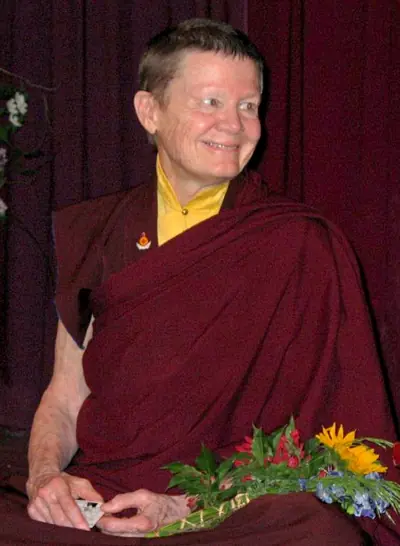
Who Is Pema Chödrön
Pema Chödrön (born Deirdre Blomfield-Brown, 1936) is an American Tibetan Buddhist nun, author, and one of the most widely read contemplative teachers of the past three decades. Ordained in the Shambhala tradition under Chögyam Trungpa Rinpoche, she served for years as the resident teacher and director of Gampo Abbey in Nova Scotia—the first Tibetan Buddhist monastery in North America established for Westerners. Her teaching style is distinctive: warm, self-revealing, psychologically astute, and entirely free of the grandiosity that can creep into spiritual instruction.
What makes her work so relevant to the IMHU conversation is her focus on the places where spiritual practice and psychological pain actually meet. She doesn't teach around suffering—she teaches into it. Her central message is that the uncomfortable, groundless, anxious feelings most people spend their lives running from are themselves the raw material of awakening. This reframe—that the very experiences we pathologize or flee from can become our teachers—has made her writing enormously popular with people navigating depression, anxiety, grief, addiction, and spiritual crisis.
Core Concepts
- Groundlessness as the human condition: Pema Chödrön's foundational teaching is that the ground we spend our lives trying to stand on—certainty, security, a stable sense of self—doesn't actually exist. Life is fundamentally groundless, and most of our suffering comes from fighting that fact rather than from the groundlessness itself. This isn't nihilism; it's an invitation to develop a different relationship with uncertainty—one based on curiosity and openness rather than panic. For anyone experiencing spiritual emergency or existential crisis, this reframe can be genuinely life-changing. (Wikipedia)
- Sitting with discomfort (tonglen and "staying"): Where many spiritual teachers emphasize transcendence, bliss, or escape from pain, Chödrön teaches the practice of staying—learning to be present with difficult emotions without acting out, shutting down, or running away. Her signature practice is tonglen, a Tibetan meditation in which you breathe in suffering (your own or others') and breathe out relief and compassion. It's a radical reversal of the instinct to push pain away, and it has real clinical utility for people who habitually dissociate, suppress, or self-medicate.
- Shenpa — the hook of habitual reaction: Chödrön popularized the Tibetan concept of shenpa—roughly translated as "the charge," "the hook," or "the urge." It's the moment when something triggers you and you feel the pull toward your habitual reaction: reaching for the drink, firing off the angry email, spiraling into self-criticism. She teaches that the practice isn't to never feel the hook—it's to notice it, pause, and choose not to bite. This maps beautifully onto cognitive-behavioral and mindfulness-based relapse prevention frameworks.
- Compassion that includes yourself: A recurring theme is that genuine compassion has to begin with self-compassion, and that spiritual practice without self-kindness can become another form of aggression—a way of beating yourself up for not being enlightened enough. She's particularly good at reaching people who have internalized harsh inner critics, whether through religious conditioning, trauma, or perfectionistic cultures.
- The wisdom of no escape: The title of one of her books, this concept encapsulates her entire approach: there is no escape from being human, from suffering, from uncertainty. And that's not bad news—it's the starting point of real freedom. Once you stop looking for the exit, you can actually begin to live. This teaching has particular resonance for people in spiritual crisis who feel trapped between a worldview that no longer works and one that hasn't yet solidified.
Essential Writings
- When Things Fall Apart: Heart Advice for Difficult Times (1997): Her most beloved book, and for good reason. Written in short, accessible chapters, it addresses loss, fear, uncertainty, and emotional pain with extraordinary directness and gentleness. Best use: the first book to hand someone going through a crisis—spiritual, relational, or existential. It meets you exactly where you are.
- The Places That Scare You: A Guide to Fearlessness in Difficult Times (2001): A deeper dive into the warrior-compassion teachings of the Shambhala tradition, this book introduces tonglen practice and the bodhisattva path in language that's immediately practical. Best use: for anyone ready to move from coping to actually growing through difficulty.
- Start Where You Are: A Guide to Compassionate Living (1994): Organized around traditional Tibetan mind-training slogans (lojong), this book offers bite-sized teachings on compassion, patience, and working with difficult emotions. Best use: a daily practice companion—open to any page and find something useful.
- Comfortable with Uncertainty: 108 Teachings on Cultivating Fearlessness and Compassion (2002): A compilation of her most essential teachings, organized for easy access. Best use: the "greatest hits" version—ideal if you want the core insights without committing to a full book.
Image Attribution
Pema Chödrön, Practising Peace at Times of War with Richard Reoch at Omega Institute, May 28th 2007. Source: https://www.flickr.com/photos/64954998@N00/520966065/. Author: https://www.flickr.com/people/64954998@N00 and link: https://commons.wikimedia.org/wiki/File:Pema_chodron_2007_cropped.jpg