


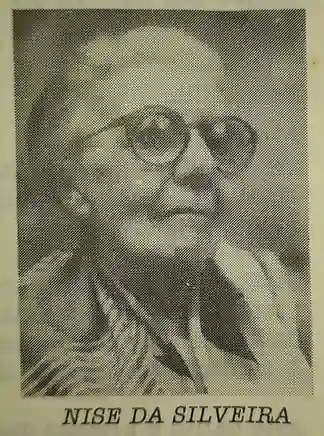
Who Is Nise da Silveira
Nise da Silveira (1905–1999) was a Brazilian psychiatrist who pioneered a radically humanistic approach to the treatment of mental illness, particularly schizophrenia, at a time when the dominant methods in Brazilian (and global) psychiatry were lobotomy, electroshock, and chemical restraint. Trained at the Medical School of Bahia and working for most of her career at the Pedro II Psychiatric Center in Rio de Janeiro, Nise refused to apply the violent treatments mandated by her institution and was reassigned to the occupational therapy section—a departmental backwater that she transformed into one of the most important experiments in psychiatric history.
In 1946, Nise established art studios and therapeutic workshops within the psychiatric hospital, providing patients—many of whom had been institutionalized for years and were considered beyond help—with painting supplies, clay, and a supportive environment in which to create freely without direction or interpretation imposed from outside. The results were extraordinary: patients produced artworks of remarkable power, beauty, and psychological depth, many exhibiting imagery that corresponded strikingly to Jungian archetypes and mandala symbolism. Nise had studied the work of Carl Jung and corresponded with him directly; Jung was deeply impressed by the artwork and recognized in it confirmation of his theories of the collective unconscious. In 1952, Nise founded the Museum of Images of the Unconscious (Museu de Imagens do Inconsciente) in Rio de Janeiro to house and display the growing collection, which eventually numbered over 350,000 works. Her approach—treating psychiatric patients as creative beings with rich inner lives rather than as objects of clinical management—anticipated the anti-psychiatry movement, art therapy, and contemporary trauma-informed care by decades. She remains one of Brazil's most celebrated intellectual and humanitarian figures.
Core Concepts
- Art as a window into the unconscious, not a symptom to be managed
- Nise's foundational principle was that the spontaneous artistic expression of psychiatric patients is not a symptom of pathology but a meaningful communication from the unconscious—one that deserves respect, attention, and serious study. She demonstrated that patients considered "hopeless" were capable of producing work of genuine artistic and psychological significance when given a supportive, non-coercive environment. (Wikipedia)
- The therapeutic relationship over institutional violence
- Nise's refusal to use lobotomy, electroshock, and physical restraint was not merely a negative stance—it was grounded in a positive conviction that the therapeutic relationship itself is the primary agent of healing. She emphasized presence, patience, and genuine regard for the patient's inner world as the foundation of care, anticipating person-centered and trauma-informed approaches by decades.
- Jungian archetypes in psychotic experience
- Through careful study of thousands of artworks, Nise documented the recurring appearance of archetypal images—mandalas, spirals, cosmic imagery, mythological figures—in the art of patients with schizophrenia, supporting Jung's theory that the collective unconscious manifests with particular intensity in psychotic states. She argued that these images represent not disintegration but the psyche's attempt at self-healing and reintegration.
- The Museum of Images of the Unconscious as living archive
- Nise's creation of the Museum was a radical act: it asserted that the artistic productions of psychiatric patients belong not in clinical files but in public cultural space, where they can be seen, studied, and honored as genuine contributions to human understanding. The Museum continues to function as both a therapeutic space and a cultural institution, holding one of the largest collections of outsider art in the world.
Essential Writings
- Imagens do Inconsciente (Images of the Unconscious)
- Nise's major work: a detailed study of the artwork produced by her patients, organized as case studies that trace the evolution of individual patients' imagery over months and years. It demonstrates her method of reading the art as a meaningful narrative of the psyche's struggle toward integration. Available primarily in Portuguese.
- Best use: the essential scholarly text—read it for the case studies, which are among the most moving documents in psychiatric literature.
- Jung: Vida e Obra (Jung: Life and Work)
- Nise's accessible introduction to Jungian psychology, written for a Brazilian audience. It reveals the theoretical framework that informed her clinical practice and her understanding of the artwork her patients produced.
- Best use: for readers who want to understand the Jungian foundations of Nise's approach—a clear and passionate introduction to the ideas that guided her work.
- Nise: The Heart of Madness (film, directed by Roberto Berliner, 2015)
- A critically acclaimed Brazilian film dramatizing Nise's work at the Pedro II Psychiatric Center, focusing on her struggle against institutional resistance and her transformative relationships with her patients. It brings her story to life with emotional power and historical accuracy.
- Best use: the most accessible entry point—watch it to understand the human dimension of Nise's work before engaging with the written texts.