


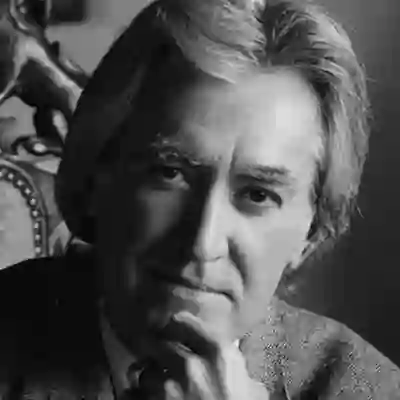
Who Is Larry Dossey
Larry Dossey is an American physician, author, and former Executive Editor of the peer-reviewed journals Alternative Therapies in Health and Medicine and Explore: The Journal of Science and Healing. Born in 1940 in Texas, Dossey trained as an internist and served as a battalion surgeon in Vietnam, where he was decorated for valor. After returning from the war and entering private practice, he began encountering patients whose recoveries defied conventional medical explanation—experiences that pushed him toward a decades-long investigation of the relationship between consciousness, meaning, and healing.
Dossey’s signature contribution is the concept of “nonlocal mind”—the idea that consciousness is not confined to the brain or the body but operates beyond the boundaries of space and time. He introduced this framework in his 1989 book Recovering the Soul, and it has since been adopted by researchers and clinicians exploring the role of intention, prayer, and distant healing in health outcomes. His 1993 bestseller Healing Words helped catalyze a dramatic shift in medical education: before its publication, only three U.S. medical schools offered courses on the role of spirituality and prayer in health; today, nearly 80 do—many using Dossey’s work as a textbook. Through thirteen books, hundreds of articles, and frequent appearances on platforms like Oprah and CNN, Dossey has become one of the most visible advocates for integrating spiritual and meaning-based perspectives into evidence-based medical care.
Core Concepts
- “Nonlocal mind” as a framework for consciousness
- Dossey’s central thesis is that mind is not produced by the brain but rather transmitted through it—and that this “nonlocal” quality of consciousness explains phenomena like distant healing, premonitions, and shared experiences between people who are physically separated. He positions this not as mysticism but as an inference from converging lines of research in parapsychology, quantum physics, and clinical medicine. (dosseydossey.com)
- Three eras of medicine
- He organizes medical history into three phases: Era I (mechanistic, body-as-machine medicine starting in the mid-1800s), Era II (mind-body medicine, acknowledging that thoughts and emotions affect physiology), and Era III (nonlocal medicine, in which consciousness itself—including prayer, intention, and empathy—becomes a therapeutic tool that operates beyond the individual body). His argument is not that Era III replaces the others, but that each era builds on the last. (BU Review)
- Meaning as medicine
- Across all of his work, Dossey emphasizes that the meaning a patient assigns to their illness—and the meaning a physician brings to the encounter—profoundly shapes outcomes. He argues that modern medicine’s focus on mechanism has come at the cost of meaning, and that restoring meaning to clinical encounters is both ethical and therapeutic.
- Prayer and intention as legitimate clinical variables (and the controversy)
- Dossey is probably best known for his insistence that intercessory prayer and healing intention deserve rigorous scientific study—and that existing data is more supportive than mainstream medicine acknowledges. Critics like David Gorski have pushed back hard, arguing that Dossey overstates the evidence and misrepresents research methodology. (Wikipedia)
- My take: Dossey’s philosophical contribution—that consciousness, meaning, and relationship belong in the healing equation—has aged well. His evidentiary claims about nonlocal healing remain genuinely contested, and readers should engage the primary literature rather than accepting either side’s summary.
Essential Writings
- Healing Words: The Power of Prayer and the Practice of Medicine
- The book that broke through: Dossey’s New York Times bestseller making the case that prayer has measurable effects on health outcomes, drawing on clinical studies and his own experience as a physician. It catalyzed the integration of spirituality courses into dozens of medical school curricula.
- Best use: a provocation—read it to understand why this conversation matters, then follow up with the primary studies yourself.
- Recovering the Soul: A Scientific and Spiritual Search
- The book where Dossey first articulated the concept of nonlocal mind—arguing that consciousness extends beyond the brain and body, with implications for how we understand death, healing, and the nature of selfhood.
- Best use: a philosophical anchor for anyone trying to reconcile subjective spiritual experience with a respect for science.
- Reinventing Medicine: Beyond Mind-Body to a New Era of Healing
- Dossey’s most structured presentation of his three-era model of medicine, with case studies and research summaries showing why he believes medicine must evolve beyond both the mechanistic and mind-body paradigms into a consciousness-inclusive framework.
- Best use: the best single overview of Dossey’s entire worldview—start here if you’re reading one book.
- One Mind: How Our Individual Mind Is Part of a Greater Consciousness and Why It Matters
- A later-career synthesis where Dossey extends the nonlocal mind idea into a full-blown vision of shared consciousness—drawing on near-death experiences, animal behavior, creative breakthroughs, and more to argue that all individual minds participate in a single, infinite field of awareness.
- Best use: a consciousness-first worldview book—especially resonant for readers already drawn to ideas like collective unconscious, interbeing, or nondual awareness.