


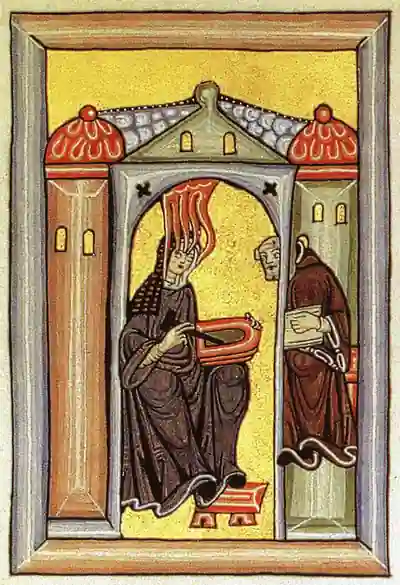
Who Is Hildegard of Bingen
Hildegard of Bingen (1098–1179) was a German Benedictine abbess, mystic, composer, philosopher, naturalist, and medical practitioner who is one of the most extraordinary figures in Western history. Born into a noble family in the Rhineland, she was given to the church as a child and spent her life in monastic communities, eventually founding her own convent at Rupertsberg near Bingen. From the age of three, she experienced vivid visions—what she described as a “living light” (lux vivens) that accompanied her throughout her life and became the basis for her theological, scientific, and artistic work. After years of keeping her visions private, she began recording them in her early forties with the encouragement of her confessor and, eventually, papal approval. She went on to produce an astonishing body of work: three major visionary treatises, two books of natural history and medicine, a cycle of more than seventy liturgical songs, a morality play, an invented language, and a vast correspondence with popes, emperors, bishops, and abbots.
Hildegard’s relevance to IMHU’s mission lies in her radical integration. She did not compartmentalize her visionary experience into a “spiritual” category separate from her understanding of the body, nature, medicine, or community life. For Hildegard, the same divine energy (viriditas—“greening power”) that animates the cosmos animates the human body, and health is a matter of alignment with this living force. Her medical writings anticipate integrative and holistic medicine by nearly a millennium, her music was composed as a form of healing and contemplative practice, and her visionary theology treats the human being as a microcosm of the whole creation. She was declared a Doctor of the Church by Pope Benedict XVI in 2012—one of only four women to hold that title. (Wikipedia) Her work has found new audiences among people seeking models of spirituality that honor the body, the natural world, and the full range of human creativity.
Core Concepts
- Viriditas (greening power): Hildegard’s signature concept. Viriditas is the vital, creative, life-giving force that flows through all of creation—through plants, animals, the human body, and the soul. It is the divine energy that makes things grow, flourish, and heal. When a person is in right relationship with God, self, and nature, viriditas flows freely; when they are out of alignment—through sin, stress, neglect of the body, or disconnection from nature—viriditas dries up, and illness (physical, psychological, or spiritual) results. This concept provides a remarkably holistic framework for understanding health and disease, one that integrates what we would now call physical, mental, and spiritual dimensions into a single continuum.
- The human being as microcosm: Hildegard taught that the human being mirrors the structure of the cosmos: the elements of the body correspond to the elements of the earth, the rhythms of the body echo the rhythms of the seasons, and the soul’s relationship to the body parallels God’s relationship to creation. This microcosm-macrocosm vision means that caring for the body is not separate from spiritual practice—it is spiritual practice. And understanding the natural world is not separate from understanding the self. This integrative vision anticipates contemporary interests in embodiment, ecological spirituality, and the connection between planetary and personal health.
- Visionary experience as knowledge: Hildegard was insistent that her visions were not dreams, fantasies, or ecstatic trances but a distinctive mode of perception—she saw the “living light” while fully awake and in her right mind. She understood her visions as a form of genuine knowledge, given by God but requiring her own intellectual and creative effort to interpret and communicate. This is significant for IMHU’s concerns because it presents a model of mystical experience that is neither pathological nor anti-intellectual: it is a way of knowing that works alongside, not against, reason and observation.
- Music as medicine and prayer: Hildegard composed more than seventy liturgical songs—antiphons, hymns, sequences, and a complete morality play (Ordo Virtutum)—and she understood music as a direct expression of the soul’s harmony with the divine. She believed that singing restored the soul to its original viriditas and that the absence of music was a form of spiritual illness. Her compositions are hauntingly beautiful and have experienced a remarkable revival in modern performance. For IMHU, her work provides a historical precedent for the therapeutic use of music, sound, and artistic expression in contemplative and healing contexts.
- Holistic medicine—body, soul, and cosmos: Hildegard’s medical works (Causae et Curae and Physica) describe a comprehensive system of healing that integrates herbal remedies, dietary guidance, gemstone therapy, and attention to emotional and spiritual states. She treated the body not as a machine to be fixed but as a living system embedded in a larger web of natural and divine forces. While her specific remedies reflect medieval understanding, her fundamental orientation—treating the whole person in their environmental and spiritual context—aligns with the principles of integrative medicine and anticipates the biopsychosocial-spiritual model of health.
Essential Writings
- Scivias (Know the Ways, 1151): Hildegard’s first and most famous visionary work, containing twenty-six visions organized in three parts, covering creation, redemption, and the virtues. Each vision is accompanied by a striking illustration (from the original illuminated manuscript) and Hildegard’s own theological commentary. Best use: the essential starting point for Hildegard’s visionary theology—rich, vivid, and unlike anything else in medieval literature.
- Liber Divinorum Operum (Book of Divine Works, 1163–1174): Hildegard’s most mature visionary work, presenting ten visions that map the relationship between the human being, the cosmos, and the divine. It contains her fullest development of the microcosm-macrocosm theme. Best use: the deepest expression of Hildegard’s integrative vision—demanding but extraordinarily rewarding.
- Physica and Causae et Curae (Natural History and Causes and Cures): Hildegard’s medical and scientific works, covering herbs, animals, gemstones, the elements, and the treatment of disease. Best use: for readers interested in Hildegard’s approach to healing and the body—a fascinating window into medieval holistic medicine.
- Symphonia (collected musical compositions): Hildegard’s liturgical songs, available in modern editions and numerous recordings. Best use: the most immediate way to experience Hildegard’s vision—her music communicates what her prose can only describe. Listen before you read.