


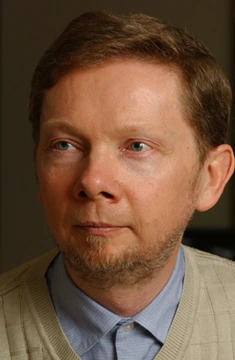
Who Is Eckhart Tolle
Eckhart Tolle (born Ulrich Leonard Tölle, 1948) is a German-born, Canada-based spiritual teacher and author whose books The Power of Now (1997) and A New Earth (2005) have sold tens of millions of copies worldwide and made him one of the most widely read spiritual authors of the twenty-first century. His teaching is rooted in a personal experience of spontaneous awakening at age 29: after years of severe depression and suicidal ideation, he underwent a dramatic inner transformation that dissolved his identification with his thinking mind and left him in a state of deep peace and presence that became the foundation of his subsequent teaching. (Wikipedia)
Tolle occupies an interesting position in the IMHU landscape. He is not a therapist, a scientist, or a scholar of any particular tradition, and his teachings draw freely (and usually without attribution) from Advaita Vedanta, Zen Buddhism, Christian mysticism, and Sufism. What he offers instead is an extraordinarily accessible distillation of contemplative insight into everyday language—a translation of what traditions have taught for millennia into terms that someone with no spiritual background can immediately grasp. This accessibility is both his strength and his limitation: he reaches people that traditional teachers never would, but he sometimes oversimplifies dynamics that are more complex than his framework acknowledges, particularly around trauma, mental illness, and the difference between genuine awakening and spiritual bypass.
Core Concepts
- The pain-body: Tolle’s most original psychological concept is the “pain-body”—an accumulated residue of emotional pain from the past that lives in the body and periodically “activates,” hijacking thoughts and behavior. When the pain-body is active, you identify with it completely and become your suffering. When you learn to observe it without identification, its grip loosens. This concept, while not clinically precise, maps usefully onto what trauma-informed therapists describe as emotional flashbacks, triggered states, and implicit memory activation. Many people have found it a helpful first framework for understanding why they suddenly feel overwhelmed by emotion for no apparent reason.
- Identification with the thinking mind as the root of suffering: Tolle’s central teaching is that most human suffering is caused not by circumstances but by compulsive identification with the stream of thought—the inner narrator that judges, worries, regrets, and plans. He argues that you are not your thoughts; you are the awareness that observes them. This is essentially a popular restatement of the witness consciousness taught across contemplative traditions, and it remains a powerful entry point for people encountering this idea for the first time.
- Presence as the primary spiritual practice: For Tolle, the practice is simple: bring your attention fully into the present moment. The ego (which he defines as the mind’s identification with past and future) cannot survive in the present. This isn’t a technique so much as a reorientation—a recognition that most of what we call “problems” exist only in the mind’s projection of past and future, not in the actual now. While this can be genuinely liberating, it can also be misused as spiritual bypass when applied to situations that require action, processing, or professional help.
- The ego as a mental construct, not an enemy: Tolle describes the ego not as something to be destroyed but as a pattern of identification to be seen through. Once you recognize the ego as a habitual mental pattern rather than who you actually are, it loses its power. This is subtler than it might appear in his popular presentation—he’s not advocating for ego annihilation but for a shift in the center of gravity from thought-identification to aware presence.
- Collective transformation through individual awakening: Particularly in A New Earth, Tolle argues that humanity is at an evolutionary inflection point: the old ego-based consciousness is destroying the planet and producing escalating suffering, and the only solution is a widespread shift toward presence-based awareness. This is a large claim, and it echoes similar arguments from Ken Wilber, Sri Aurobindo, and Teilhard de Chardin, though Tolle’s version is more accessible and less theoretically elaborate.
Essential Writings
- The Power of Now (1997): The book that made Tolle famous. Written as a dialogue between teacher and questioner, it presents his core teachings on presence, ego, the pain-body, and the nature of consciousness in simple, direct language. Best use: still the best entry point for people who have never encountered contemplative or nondual teachings before. Read it with the understanding that it’s a popularization, not a complete spiritual system.
- A New Earth: Awakening to Your Life’s Purpose (2005): A broader, more socially engaged book that extends Tolle’s individual teachings to the collective level, arguing that ego-driven consciousness is the source of most human dysfunction and that a shift is possible. Oprah Winfrey’s selection of this book for her book club brought it to an audience of millions. Best use: for readers who found The Power of Now helpful and want to see how the ideas apply to relationships, work, and the state of the world.
- Stillness Speaks (2003): A collection of short, aphoristic teachings organized by theme. Less systematic than his other books but useful for contemplation. Best use: a daily companion—open to any page and sit with what you find.
Image Attribution
“Eckhart Tolle side.jpg” by Kyle Hoobin, via Wikimedia Commons, licensed CC BY-SA 3.0. Link: https://commons.wikimedia.org/wiki/File%3AEckhart_Tolle_side.jpg