


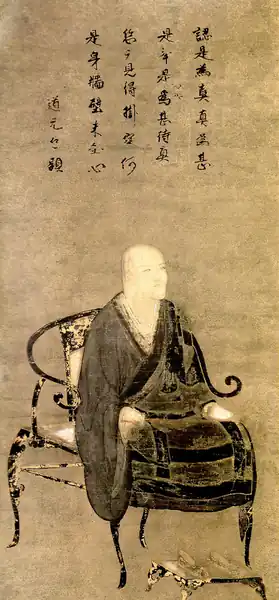
Who Is Dōgen Zenji
Dōgen Kigen (1200–1253) was a Japanese Zen master, philosopher, poet, and the founder of the Sōtō school of Zen Buddhism in Japan. Born into an aristocratic family in Kyoto, Dōgen lost both parents by age seven and entered monastic life as a teenager. Dissatisfied with the state of Japanese Buddhism, he traveled to China in 1223 and studied under Tiantong Rujing, a Chan master who emphasized shikantaza (just sitting)—meditation without any particular object, goal, or technique. Dōgen experienced a deep awakening and returned to Japan in 1227, where he spent the rest of his life teaching, writing, and establishing Eiheiji, the monastery that remains the headquarters of Sōtō Zen to this day. (Wikipedia)
Dōgen’s relevance to IMHU’s mission is both philosophical and practical. He is widely regarded as one of the most profound and original thinkers in the entire Buddhist tradition—and arguably in world philosophy. His masterwork, the Shōbōgenzō (Treasury of the True Dharma Eye), is a vast, dense, and endlessly generative collection of essays that investigate the nature of time, being, language, practice, and awakening with an intellectual rigor and literary beauty that has drawn comparisons to Heidegger, Wittgenstein, and Meister Eckhart. But Dōgen is not merely a philosopher—he is fundamentally a teacher of practice. His central teaching—that zazen (seated meditation) is not a means to enlightenment but the very expression of enlightenment itself—cuts through the spiritual striving and achievement-orientation that can distort contemplative practice. For clinicians and practitioners who work with people who have turned meditation into another performance, Dōgen offers a radical reframe: you are not practicing to become something; you are expressing what you already are.
Core Concepts
- Shikantaza (just sitting): Dōgen’s primary practice instruction. Shikantaza means sitting with complete, alert presence—without concentrating on any object, without following the breath toward a goal, without trying to achieve any particular state. It is meditation stripped to its essence: just being aware, just sitting, just this. The practice sounds simple but is extraordinarily demanding, because it requires letting go of every subtle form of doing, striving, and self-improvement that the mind habitually engages in. For people whose meditation has become another achievement project, shikantaza is a powerful corrective.
- Practice-enlightenment (shushō ittai): Dōgen’s most important philosophical contribution. He rejected the common understanding that practice is a means to reach enlightenment at some future point. Instead, he taught that practice and enlightenment are one and the same: the very act of sitting in zazen is itself the expression of Buddha-nature. You don’t practice to become a Buddha; practice is being Buddha. This non-dual understanding of practice dissolves the gap between “here” (where you are) and “there” (where you want to get), and it has profound implications for how we understand the relationship between effort and grace, doing and being.
- Being-time (uji): In his essay Uji, Dōgen presents a radical philosophy of time. He argues that time is not a container through which beings move; rather, each moment of time is a complete expression of being, and each being is a complete expression of time. The mountain is time; the river is time; your sitting is time. This collapses the conventional distinction between temporal and eternal and suggests that the present moment—fully inhabited—is itself the totality. While this teaching is philosophically dense, its experiential implication is simple and powerful: stop waiting for the right time and realize that this time is the right time.
- The sacredness of ordinary activity: Dōgen wrote detailed instructions for cooking (the Tenzo Kyōkun), washing, eating, and using the bathroom—not because he was obsessed with rules but because he understood that awakened activity is not confined to the meditation hall. Every act, performed with full attention and care, is practice. The cook who prepares food mindfully is expressing Buddha-nature no less than the monk in deep samadhi. This teaching anticipates the modern emphasis on integrating mindfulness into daily life rather than confining it to formal practice sessions.
- Genjokoan (the actualization of reality): The opening essay of the Shōbōgenzō and Dōgen’s most cited text. It addresses the fundamental question of how enlightenment manifests in the midst of ordinary life. Dōgen writes: “To study the Buddha Way is to study the self. To study the self is to forget the self. To forget the self is to be enlightened by the ten thousand things.” This progression—from self-investigation to self-forgetting to receiving the world—maps a contemplative journey that is at once deeply Buddhist and universally recognizable.
Essential Writings
- Shōbōgenzō (Treasury of the True Dharma Eye): Dōgen’s masterwork—a collection of approximately ninety-five essays composed over twenty years. It is one of the most profound and challenging works in Buddhist literature. Best use: the essential text—not meant to be read cover to cover but explored essay by essay, slowly, over time. Start with “Genjokoan” and “Uji.”
- Shōbōgenzō Zuimonki (Record of Things Heard): Informal talks recorded by Dōgen’s student Koun Ejō. Much more accessible than the Shōbōgenzō, it captures Dōgen in a warm, practical, teacher-student mode. Best use: the best starting point for readers new to Dōgen—direct, personal, and immediately applicable.
- Tenzo Kyōkun (Instructions for the Cook): Dōgen’s manual for the monastery cook, treating cooking as a form of spiritual practice. Brief and luminous. Best use: a perfect introduction to Dōgen’s vision of practice in daily life—readable in an hour, applicable for a lifetime.
- Moon in a Dewdrop: Writings of Zen Master Dōgen (edited by Kazuaki Tanahashi): A carefully selected anthology of Dōgen’s key essays and poems with helpful introductions. Best use: the most accessible curated collection for Western readers—an excellent companion to the full Shōbōgenzō.