


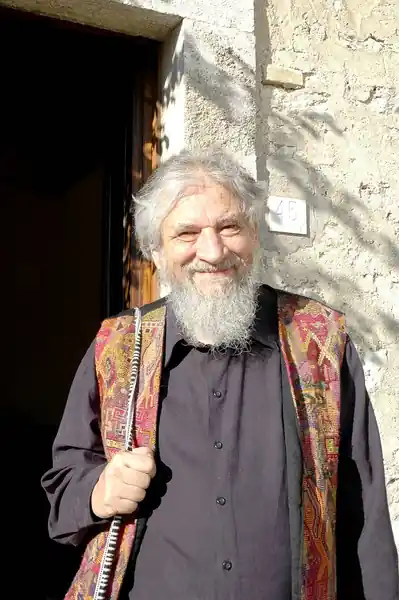
Who Is Claudio Naranjo
Claudio Naranjo (1932–2019) was a Chilean-born psychiatrist, educator, and author who made significant contributions to three intersecting fields: psychedelic-assisted psychotherapy, the modern Enneagram of personality, and the integration of contemplative practice into education. Trained as a psychiatrist at the University of Chile and later at Harvard and UC Berkeley, Naranjo was part of the pioneering circle of researchers at the Esalen Institute in Big Sur during the 1960s and early 1970s, where he worked alongside Fritz Perls (Gestalt therapy), Alexander Shulgin (psychopharmacology), and other figures at the intersection of psychology, spirituality, and consciousness research.
Naranjo’s career unfolded in three major phases. In the 1960s–70s, he conducted some of the earliest clinical research on MDMA (which he called “the penicillin of the soul”), MDA, ibogaine, and harmaline in therapeutic settings, documenting their effects on self-awareness, empathy, and psychological insight. In the 1970s–80s, he became one of the principal figures responsible for bringing the Enneagram of personality types to the West—he studied the system with Oscar Ichazo in Arica, Chile, then developed it into a psycho-spiritual tool that integrated insights from Gestalt therapy, object relations, and contemplative traditions. His Enneagram work, transmitted through his students (including Helen Palmer and Don Riso), became one of the most widely used personality frameworks in psychology, business, and spiritual direction. In his later decades, Naranjo focused on what he called the SAT Program (Seekers After Truth)—intensive workshops combining meditation, Enneagram work, music, and therapeutic process—and on advocating for the transformation of education as the primary lever for changing human consciousness.
Core Concepts
- The Enneagram as a map of character and neurosis
- Naranjo’s most widely influential contribution was developing the Enneagram of personality from Ichazo’s prototypical framework into a detailed psychological system. He mapped each of the nine types to specific patterns of neurotic character structure, drawing on psychoanalytic theory, Gestalt therapy, and his own clinical experience. His key insight was that each type represents a specific strategy for dealing with early emotional pain—a “passion” (emotional fixation) and a “fixation” (cognitive distortion) that together create a self-reinforcing personality structure. (Wikipedia)
- Psychedelic therapy as a tool for self-knowledge
- Naranjo was among the first clinicians to systematically use MDMA, MDA, and ibogaine in therapeutic settings, documenting their capacity to lower psychological defenses, enhance empathy, and facilitate access to repressed emotional material. His approach was integrative: psychedelics were tools within a broader therapeutic process, not standalone experiences. His early MDMA work anticipated by decades the current clinical trials using MDMA for PTSD.
- The integration of therapy, meditation, and character work
- Naranjo’s SAT Program combined Enneagram analysis, Gestalt process, Vipassana and Tibetan meditation, movement, and music into an intensive transformational experience. His conviction was that genuine transformation requires working simultaneously on psychological structure (therapy), contemplative depth (meditation), and character understanding (Enneagram)—and that no single modality is sufficient on its own.
- Education as the lever for civilizational change
- In his later career, Naranjo argued that the most consequential application of everything he had learned was the transformation of education. He advocated for curricula that develop emotional intelligence, self-knowledge, and contemplative capacity alongside cognitive skills, and he worked with schools and governments in Latin America and Europe to implement these ideas.
Essential Writings
- Character and Neurosis: An Integrative View
- Naranjo’s definitive statement on the Enneagram: a detailed clinical portrait of all nine types, integrating psychoanalytic theory, Gestalt therapy, and contemplative psychology. It is the most psychologically rigorous Enneagram book available and the foundation for most subsequent clinical applications.
- Best use: the essential Enneagram text for anyone who wants depth rather than pop psychology—especially therapists and serious self-investigators.
- The Healing Journey: Pioneering Approaches to Psychedelic Therapy
- Naranjo’s account of his clinical work with psychedelics—including MDA, MDMA, ibogaine, and harmaline—in the 1960s and 70s. It documents specific therapeutic techniques, session protocols, and case studies from a period when this work was legal and institutionally supported.
- Best use: essential historical reading for anyone in the psychedelic therapy field—Naranjo’s clinical observations remain relevant to current practice.
- Ennea-type Structures: Self-Analysis for the Seeker
- A more accessible companion to Character and Neurosis, designed for personal self-study rather than clinical application. Each type is presented with practical descriptions and suggestions for self-observation.
- Best use: the best self-study Enneagram book for readers who want Naranjo’s psychological depth without the clinical framework.
Image Attribution
“Claudio Naranjo close-up (cropped).JPG” by Empiricus777, via Wikimedia Commons, CC0. Link: https://commons.wikimedia.org/wiki/File%3AClaudioNaranjo.JPG?utm_source=chatgpt.com