


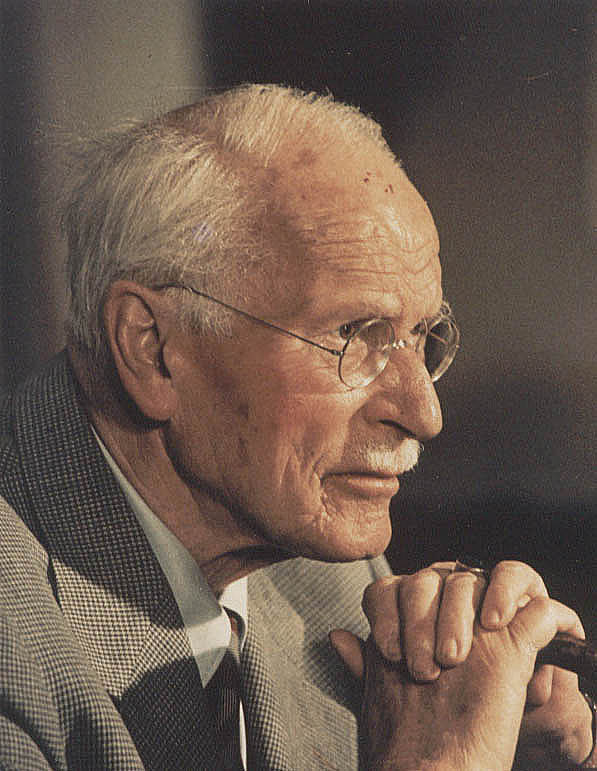
Who Is Carl Jung
Carl Gustav Jung (1875–1961) was a Swiss psychiatrist and psychoanalyst who founded analytical psychology, a tradition that diverged from Freud’s psychoanalysis by insisting that the psyche contains not only personal memories and repressed material but also a deeper layer—the collective unconscious—populated by universal patterns he called archetypes. Trained in medicine at the University of Basel and later at the Burghölzli psychiatric hospital in Zurich, Jung spent his early career doing word-association experiments that helped establish the reality of unconscious complexes. His collaboration with Freud (roughly 1907–1913) was intense and productive, but their split was inevitable: Jung could not accept Freud’s insistence that libido was essentially sexual, and Freud could not follow Jung into the territory of mythology, religion, and the transpersonal.
What makes Jung permanently central to IMHU’s mission is that he took spiritual and numinous experience seriously as psychological data—not as illusion, not as pathology, but as the psyche’s own activity seeking wholeness. His concept of individuation—the lifelong process of integrating conscious and unconscious elements into a more complete self—is essentially a psychological model of spiritual maturation. His work on dreams, active imagination, synchronicity, and the shadow gave clinicians a vocabulary for working with the inner life that neither reduces it to neuroscience nor inflates it into metaphysics. Virtually every subsequent attempt to bridge depth psychology and spirituality—transpersonal psychology, psychedelic integration, Jungian analysis, archetypal psychology—owes a foundational debt to Jung.
Core Concepts
- The collective unconscious and archetypes: Jung proposed that beneath the personal unconscious lies a deeper stratum shared by all humans, containing inherited patterns of experience—archetypes—that manifest as recurring images, themes, and figures across cultures: the Hero, the Shadow, the Anima/Animus, the Self, the Great Mother, the Wise Old Man. These aren’t fixed images but dynamic organizing principles that shape how we perceive, feel, and act. Clinically, recognizing archetypal patterns can help people understand why certain experiences—falling in love, facing death, encountering the numinous—carry such overwhelming emotional charge. (Wikipedia)
- Individuation: The central goal of Jungian psychology is individuation—the process by which a person integrates the various parts of the psyche (persona, shadow, anima/animus, Self) into a more conscious, whole personality. It’s not about perfection; it’s about becoming more fully and honestly who you are. Jung saw this as a lifelong process that often intensifies in the second half of life, and he understood it as simultaneously psychological and spiritual. For clinicians, individuation provides a developmental framework that honors both pathology and potential.
- The shadow: The shadow is everything about ourselves that we have repressed, denied, or refused to see—not only negative qualities but also unlived potential. Jung argued that confronting the shadow is the first and most essential step in psychological growth, and that projecting it onto others is the root of much interpersonal and collective violence. Shadow work remains one of the most practically useful concepts in psychotherapy, and it maps directly onto spiritual traditions that emphasize self-honesty as prerequisite to transformation.
- Dreams and active imagination: Jung treated dreams as communications from the unconscious that compensate for the one-sidedness of conscious attitudes. Unlike Freud, who saw dreams primarily as disguised wish-fulfillment, Jung saw them as purposive—the psyche’s attempt to move toward balance. He also developed active imagination, a waking technique for dialoguing with inner figures, which anticipates many modern therapeutic approaches including Internal Family Systems and parts work.
- Synchronicity and the numinous: Jung’s concept of synchronicity—meaningful coincidences that cannot be explained by causality—was his attempt to honor experiences that fall outside the mechanistic worldview without abandoning empirical rigor. His lifelong engagement with the numinous (Rudolf Otto’s term for the experience of the sacred) informed his conviction that the psyche has a religious function—not in the sense of doctrinal belief, but in the sense of an innate orientation toward meaning, wholeness, and encounter with something greater than the ego.
Essential Writings
- Memories, Dreams, Reflections (1963): Jung’s autobiography, recorded and edited by Aniela Jaffé. It’s less a conventional life story than an inner autobiography—a map of his encounters with the unconscious, his visions, his near-death experience, and the development of his ideas. Best use: the single best entry point for understanding Jung as a person and thinker.
- The Archetypes and the Collective Unconscious (Collected Works, Vol. 9i): The primary source for Jung’s theory of archetypes and the collective unconscious, including essays on the mother archetype, the child archetype, and the concept of the Self. Best use: essential for anyone who wants to work with archetypal material in clinical or spiritual contexts.
- Psychology and Alchemy (Collected Works, Vol. 12): Jung’s most sustained exploration of how alchemical symbolism parallels the individuation process. He reads the alchemists not as proto-chemists but as unconscious psychologists whose images of transformation describe the inner work of integrating opposites. Best use: for readers ready to go deep into symbolic and transpersonal territory.
- Modern Man in Search of a Soul (1933): A collection of essays covering dreams, psychotherapy, the stages of life, and the spiritual problem of modern people. More accessible than the Collected Works, it gives a clear overview of Jung’s mature thinking. Best use: a readable introduction for people who want Jung’s key ideas without the full scholarly apparatus.
- The Red Book (Liber Novus, 2009): Jung’s private illustrated journal of his “confrontation with the unconscious” (1913–1930), published posthumously. It documents the visionary experiences and active imaginations that became the raw material for his entire later psychology. Best use: a stunning artifact of inner exploration—part art, part revelation, part case study in what it looks like to take the unconscious seriously.