


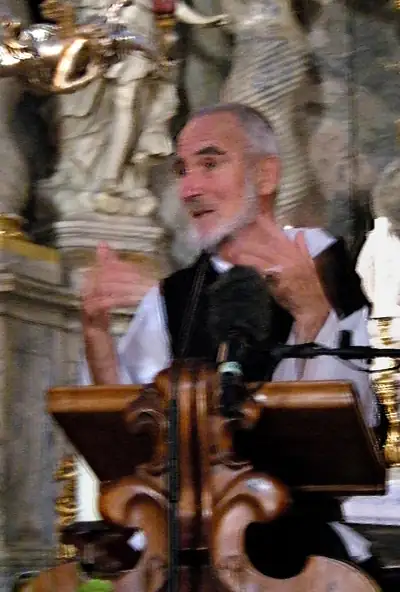
Who Is Brother David Steindl-Rast
Brother David Steindl-Rast (born 1926) is an Austrian-born Benedictine monk, author, and interfaith dialogue leader who has become one of the most widely recognized voices for contemplative spirituality in the modern world. After studying art, anthropology, and psychology in Vienna, he joined the Benedictine monastery of Mount Saviour in New York in 1953. In the 1960s, he received permission from his abbot to participate in Buddhist–Christian dialogue, studying with Zen masters including Shunryu Suzuki, Hakuun Yasutani, and Eido Shimano—making him one of the first Christian monastics to formally engage with Zen practice. This cross-traditional experience profoundly shaped his approach to spirituality, which emphasizes direct experience and contemplative practice over doctrinal adherence.
Brother David’s relevance to IMHU’s mission lies in his lifelong effort to identify and communicate the common experiential ground beneath different spiritual traditions. His central teaching—that gratitude is not merely a pleasant emotion but the foundational spiritual practice that opens the heart to the fullness of life—has reached millions through his books, talks, and the website gratefulness.org, which he co-founded. His TED talk on gratitude has been viewed millions of times, and his writing translates deep contemplative insight into language that people outside monastic or academic settings can immediately apply. For IMHU, his work demonstrates that authentic interfaith dialogue is possible when grounded in shared contemplative experience rather than theological debate, and that ancient monastic wisdom can be made relevant to contemporary seekers without diluting its depth.
Core Concepts
- Gratitude as the heart of spiritual practice
- Brother David’s most influential teaching is that gratefulness—the practice of recognizing each moment as a gift—is the fundamental spiritual attitude from which all other virtues flow. He distinguishes between thankfulness (a response to specific gifts) and gratefulness (an orientation toward the giftedness of existence itself). He teaches that this is a practice, not merely a feeling: it requires the deliberate cultivation of what he calls “stop, look, go”—pausing to interrupt habitual inattention, looking with fresh eyes at what is actually present, and then responding with appropriate action.
- Contemplative experience as the common ground of religions
- Drawing on his decades of interfaith practice, Brother David argues that the mystics of all traditions—Christian, Buddhist, Hindu, Sufi, indigenous—point toward the same fundamental reality, even though they describe it in different conceptual frameworks. He distinguishes between the institutional and doctrinal dimensions of religion (which often divide) and the contemplative-experiential dimension (which tends to unite). This framework has been enormously influential in interfaith dialogue and in helping individuals navigate spiritual seeking across traditions.
- Buddhist–Christian dialogue through shared practice
- Brother David was a pioneer in moving Buddhist–Christian dialogue from theological comparison to shared contemplative practice. His approach—sitting in Zen meditation as a Christian monk, bringing his experience of Zen back to his Benedictine practice—demonstrated that deep engagement with another tradition can enrich rather than dilute one’s own. His writing on the parallels between Zen mindfulness and Benedictine attentiveness has been particularly influential.
- Monastic wisdom for everyday life
- Throughout his work, Brother David has translated the insights of monastic life—structured contemplation, community, simplicity, presence—into practices accessible to non-monastics. He insists that the contemplative life is not reserved for those in religious orders but is available to anyone willing to cultivate attention, gratitude, and responsiveness to the present moment.
Essential Writings
- Gratefulness, the Heart of Prayer: An Approach to Life in Fullness
- Brother David’s foundational work on gratitude as spiritual practice. Draws on Christian mysticism, Zen Buddhism, and personal experience to develop a practical framework for cultivating gratefulness as a way of life. Warm, wise, and deeply personal.
- Best use: the best starting point for anyone interested in Brother David’s core teaching on gratitude and contemplative living.
- Belonging to the Universe (with Fritjof Capra)
- A dialogue between Brother David and physicist Fritjof Capra exploring the parallels between the new paradigm emerging in science and the contemplative traditions of Christianity and Buddhism. A fascinating cross-disciplinary conversation about reality, consciousness, and belonging.
- Best use: for readers interested in the dialogue between contemplative spirituality and contemporary science.
Image Attribution
“David Steindl-Rast OSB 20090926.jpg” by user:W. (attribution shown as Wolfgang H. Wögerer), via Wikimedia Commons, licensed CC BY-SA 3.0. Link: https://commons.wikimedia.org/wiki/File%3ADavid_Steindl-Rast_OSB_20090926.jpg