


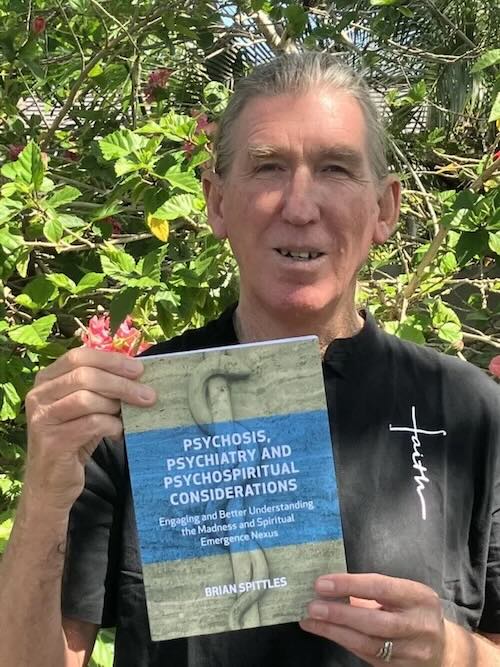
Who Is Brian Spittles
Brian Spittles is an Australian academic researcher based in Perth, Western Australia, who has spent nearly two decades working across several Perth universities in fields ranging from community and sustainable development to Australian Indigenous studies, sociology, and intercultural communication. He earned his PhD from Murdoch University in 2018 with a dissertation titled Better Understanding Psychosis: A Psychospiritual Challenge to Medical Psychiatry—a work that laid the groundwork for his broader project of questioning whether mainstream psychiatry’s materialist framework is sufficient to account for the full range of human mental experience.
Spittles is a co-Director of the recently incorporated Australian Centre for Consciousness Studies (ACCS) and a member of the Emergent Phenomenology Research Consortium (EPRC), a global multidisciplinary body that brings together clinical, scientific, and spiritual paradigms to improve therapeutic outcomes. His 2022 book Psychosis, Psychiatry and Psychospiritual Considerations represents the culmination of years of research arguing that experiences currently classified as psychotic may, in many cases, overlap with or be indistinguishable from legitimate spiritual experiences—and that psychiatry’s refusal to engage this possibility represents a significant epistemological blind spot. He is also involved in climate emergency, environmental protection, and social justice advocacy.
Core Concepts
- The psychosis–spiritual emergence nexus
- Spittles’ central argument is that psychosis, as psychiatry currently defines it, is not always a straightforward pathology. Drawing on transpersonal psychology, phenomenological research, and cross-cultural evidence, he makes the case that many psychotic experiences share striking similarities with spiritual emergencies and mystical states—and that failing to distinguish between the two can lead to misdiagnosis and iatrogenic harm. His aim is not to dismiss psychiatry but to expand its investigative parameters beyond the bounds of materialism.
- Challenging psychiatry’s epistemological limits
- A recurring theme in Spittles’ work is that mainstream psychiatry operates within a materialist epistemology that systematically excludes psychospiritual considerations from clinical practice. He argues that this is not a neutral scientific stance but an active choice—one that limits the discipline’s ability to understand and treat conditions like psychosis. His 2025 article in the Journal of Humanistic Psychology traces the history of how the DSM came to include a “Religious or Spiritual Problem” category, and critiques how narrowly that category has been applied relative to what its transpersonal originators intended.
- The DSM’s Religious or Spiritual Problem category
- In his most recent published article, Spittles provides a detailed historical account of the humanistic and transpersonal influences that led to the inclusion of the “Religious or Spiritual Problem” code (V62.89) in DSM-IV in 1994. He demonstrates that the category was originally conceived to cover a much broader range of spiritual experiences than mainstream psychiatry has been willing to recognize—and argues that expanding its diagnostic scope remains an urgent clinical need. The article also addresses the recent renaming of the category to “Moral, Religious or Spiritual Problem,” which Spittles critiques as a change that may further dilute the category’s original intent.
- Multidisciplinary and cross-paradigm research
- Through his involvement with the EPRC and the ACCS, Spittles advocates for a research methodology that is explicitly ontologically agnostic—meaning it does not assume in advance whether spiritual experiences are “real” or reducible to brain states. Instead, it seeks to document, define, and study emergent phenomenology on its own terms, using first-person, psychometric, neurophenomenological, and clinical methods. This approach allows researchers to take spiritual and anomalous experiences seriously as data without abandoning scientific rigor.
Essential Writings
- Psychosis, Psychiatry and Psychospiritual Considerations: Engaging and Better Understanding the Madness and Spiritual Emergence Nexus (2022)
- Spittles’ primary work, published by Aeon Books. Using an open-ended heuristic approach, the book examines psychosis across four “Focal Settings” that move sequentially through different paradigms of psychospiritual understanding—from conventional psychiatric frameworks through to metaphysical and spiritual perspectives. The result is a systematic challenge to core psychiatric assumptions about the nature and causes of psychosis.
- Best use: essential reading for anyone working in mental health who wants to understand the case for expanding clinical frameworks beyond materialism—particularly around psychosis, spiritual emergency, and anomalous experience.
- Better Understanding Psychosis: Psychospiritual Considerations in Clinical Settings (2023, Journal of Humanistic Psychology)
- A peer-reviewed article distilling key arguments from Spittles’ doctoral research, making the case that psychospiritual considerations belong in clinical psychosis treatment. It argues that the similarities between psychotic and benign psychotic-like spiritual experiences demand that clinicians develop competency in distinguishing between the two.
- Best use: a concise entry point for clinicians and researchers who want the core argument without the full book-length treatment.
- The Humanistic and Transpersonal Origins of the Diagnostic and Statistical Manual’s Religious or Spiritual Problem Category (2025, Journal of Humanistic Psychology)
- Spittles’ most recent published article, which endured nearly two years of editorial and peer review before finally reaching publication. It offers a detailed history of how transpersonal psychology influenced the creation of the DSM’s “Religious or Spiritual Problem” category. The article traces the intellectual lineage from humanistic and transpersonal thought through to the category’s inclusion in DSM-IV, and critiques subsequent developments through DSM-5-TR and beyond. Notably, while the article was under review, the DSM category itself was updated to “Moral, Religious or Spiritual Problem”—prompting Spittles to add an epilogue critiquing this change.
- Best use: invaluable for understanding the institutional politics behind how psychiatry has (and hasn’t) engaged with spiritual experience—and for anyone interested in the ongoing evolution of diagnostic categories around religion and spirituality.
What’s Next
Spittles is currently planning a follow-up article that will argue the case for including “spiritual emergency” as a recognized category in the DSM-5-TR text—a move that would represent a significant expansion of psychiatry’s engagement with psychospiritual experience and bring the diagnostic manual closer to the original vision of the transpersonal clinicians who first proposed the Religious or Spiritual Problem category in the early 1990s.