


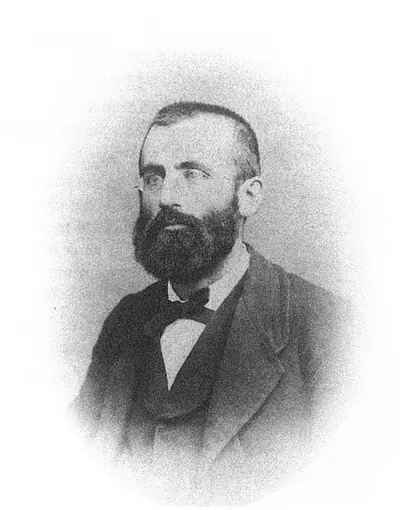
Who Is Bezerra de Menezes
Adolfo Bezerra de Menezes Cavalcanti (1831–1900) was a Brazilian physician, politician, and Spiritist leader who became one of the most important figures in the establishment of Spiritism in Brazil. Born in the northeastern state of Ceará, he studied medicine in Rio de Janeiro and built a distinguished career as a physician, serving the poor and becoming known for his compassion and clinical skill. He also served in the Brazilian Imperial Parliament. In the 1880s, Bezerra de Menezes encountered the Spiritist teachings of Allan Kardec and became an ardent convert, eventually devoting the latter part of his life to the consolidation and defense of the Spiritist movement in Brazil during a period when it faced significant opposition from both the Catholic Church and secular materialists.
Bezerra de Menezes’s relevance to IMHU’s mission lies in his pioneering effort to integrate medical practice with spiritual understanding. As both a trained physician and a committed Spiritist, he argued that genuine healing must address the spiritual dimensions of suffering—not as a rejection of scientific medicine but as its necessary complement. He became president of the Brazilian Spiritist Federation (FEB) and worked to unify the often-fractious Brazilian Spiritist movement under a coherent philosophical and ethical framework. His personal example—a respected physician and public figure who publicly embraced Spiritism and devoted his medical skills to charitable service—gave the movement credibility and moral authority. Known as the “Doctor of the Poor” for his practice of treating indigent patients without charge, he embodied the Spiritist principle that moral development and service to others are inseparable from spiritual growth. After his death, he became one of the most venerated figures in Brazilian Spiritism, and his influence continues to shape the integration of spiritual and medical approaches in Brazilian healthcare.
Core Concepts
- The integration of medicine and spiritual philosophy
- Bezerra de Menezes was among the first to argue systematically that the Spiritist understanding of the human being—as an immortal spirit temporarily incarnated in a physical body—had direct implications for medical practice. He maintained that many conditions attributed purely to physical causes also had spiritual dimensions that needed to be addressed, including the influence of discarnate spirits on the incarnate. This perspective laid the groundwork for the Spiritist complementary healthcare institutions that would later develop throughout Brazil.
- Charity as the essential expression of spiritual development
- For Bezerra de Menezes, charity was not merely a social obligation but the highest expression of moral and spiritual development. His decision to treat the poor without compensation, despite his own modest means, was understood within the Spiritist framework as the practical application of the doctrine of universal brotherhood—the idea that all spirits are evolving together and that service to others accelerates one’s own spiritual progress.
- Unification of the Brazilian Spiritist movement
- When Bezerra de Menezes assumed leadership of the Brazilian Spiritist Federation, the movement was divided between those who emphasized the scientific-experimental aspects of Spiritism (especially mediumship research) and those who emphasized its religious-moral dimensions. Bezerra de Menezes worked to synthesize these perspectives, arguing that Spiritism was simultaneously a science, a philosophy, and a moral system—and that all three aspects were essential to its integrity. This synthetic vision became the dominant framework for Brazilian Spiritism.
- Compassion and moral courage in public life
- Bezerra de Menezes’s willingness to publicly embrace Spiritism at a time when it was socially and politically risky—facing opposition from the Catholic hierarchy and skepticism from the medical establishment—demonstrated a moral courage that became central to his legacy. He argued that intellectual honesty required following the evidence of spiritual phenomena wherever it led, regardless of social consequences.
Essential Writings
- A Loucura sob Novo Prisma (Madness from a New Perspective)
- Bezerra de Menezes’s most significant written work, in which he argues that many cases of what was then classified as madness actually involve spiritual interference—the influence of discarnate spirits on incarnate individuals. While the specific framework is controversial, the work represents an early attempt to integrate spiritual factors into the understanding of mental illness, anticipating later discussions about the role of meaning, spirituality, and non-ordinary experiences in mental health.
- Best use: for researchers and historians interested in the early integration of spiritual perspectives into psychiatric thought, particularly within the Brazilian context.