


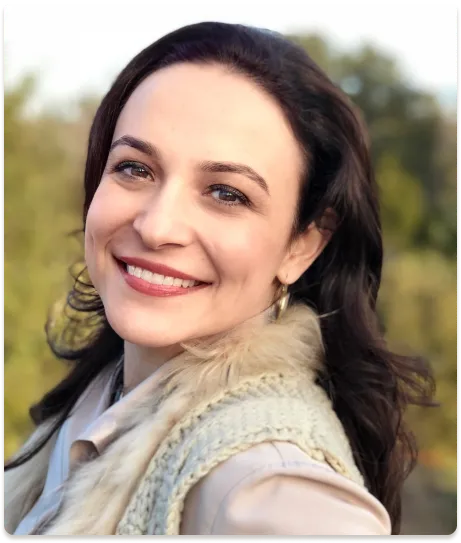
Who Is Anna Yusim, MD
Anna Yusim, MD is a board-certified psychiatrist, Clinical Assistant Professor at Yale School of Medicine, and Co-Founder of the Yale Mental Health and Spirituality Program and Center—a pioneering institutional initiative bridging Yale Medical School and Yale Divinity School. Trained in neurobiology research under Robert Sapolsky at Stanford University, in medicine at Yale School of Medicine, and in psychiatry at the NYU residency training program, she represents a new generation of mainstream-trained clinicians bringing rigorous scientific grounding to the spiritual dimensions of mental health and human flourishing.
What sets Yusim apart is the depth and breadth of her personal engagement with the traditions she draws on clinically. After completing her formal training, she traveled, lived, and worked in more than 70 countries—studying Kabbalah in Israel, Buddhist meditation in India, and working with South American shamans and Indian gurus—not as a tourist of traditions but as a genuine seeker who recognized that Western psychiatry, for all its diagnostic precision and pharmacological sophistication, was missing something essential about what makes people suffer and what allows them to genuinely heal. That personal investigation became the foundation of her clinical approach: an integrative psychiatry that takes the soul as seriously as the neurotransmitter, and that positions fulfillment—not merely the absence of symptoms—as the proper aim of psychiatric care. Her book Fulfilled (2017), published by Hachette Book Group, translates this framework for a broad audience; she has since presented her work on every continent, including Antarctica.
Core Concepts
- Spiritual neglect as an unrecognized clinical factor: Yusim's central clinical observation, developed through years of practice with high-functioning patients presenting with depression, anxiety, and existential distress, is that beneath many presenting complaints lies a deeper layer of what she calls spiritual neglect: a disconnection from meaning, purpose, and a felt sense of connection to something larger than the self. Western culture, she argues, systematically under-develops this dimension—prioritizing intellectual, professional, and material achievement over spiritual awareness—with predictable consequences for wellbeing. Addressing this disconnection requires more than symptom management; it requires a fundamental reorientation toward one's deeper nature and purpose.
- Fulfillment as a clinical concept: The organizing idea in Yusim's work is fulfillment—not happiness in the hedonic sense of pleasure and the absence of pain, but the eudaimonic sense of living in alignment with one's deepest values, purpose, and authentic self. Drawing on positive psychology, humanistic and existential traditions, neuroscience, and cross-cultural spiritual wisdom, she argues that fulfillment is not a luxury or a philosophical abstraction but a measurable dimension of mental health that clinicians can and should address directly. Patients who achieve genuine fulfillment, she has observed, show fundamentally different patterns of wellbeing than those who achieve symptom remission alone.
- Integrative psychiatry in practice: Yusim's clinical model combines conventional psychiatric tools—diagnosis, medication when indicated, evidence-based psychotherapy—with sustained attention to clients' spiritual and existential concerns. This includes exploring their sense of meaning and purpose, their relationship with spiritual or religious traditions, their experience of transcendence and connection, and the role spiritual practice might play in supporting healing and growth. She works with clients across the full range of backgrounds, from religious traditionalists to secular seekers, adapting the integrative framework to each individual's own language and lived experience.
- Science and spirituality as complementary frameworks: One of Yusim's consistent themes—expressed in her book and through her ongoing work at Yale—is that the apparent conflict between scientific and spiritual worldviews is a false opposition. The growing research base on meditation, gratitude, awe, transcendence, meaning-making, and connection provides rigorous empirical grounding for clinically integrating spiritual practices that might otherwise seem purely anecdotal or ideologically driven. She draws on neuroscience, epigenetics, positive psychology, and consciousness research to position spiritually integrated care not as an alternative to medicine but as its natural extension.
- Institutional bridge-building at Yale: Beyond her clinical practice and writing, Yusim is engaged in the institutional challenge of creating a formal home for spirituality within academic psychiatry. The Yale Mental Health and Spirituality Program and Center she is co-founding with Dr. Christopher Pittenger—designed as a bridge between Yale Medical School and Yale Divinity School—represents an attempt to ensure that future generations of clinicians receive training that takes spiritual and existential dimensions of care as seriously as pharmacology or evidence-based psychotherapy. This institutional work may prove to be her most enduring contribution to the field.
Essential Writings
- Fulfilled: How the Science of Spirituality Can Help You Live a Happier, More Meaningful Life (2017, Hachette Book Group): Yusim's trade book and the primary vehicle for her integrative clinical framework, drawing on case studies, personal narrative, and research literature to argue that spiritual connection is not a supplement to mental health but one of its foundations. Filled with exercises, guided meditations, and empirical evidence, it offers a model of psychological thriving that addresses the full depth of human experience. Best use: the most accessible and comprehensive introduction to her clinical philosophy—and a useful resource to share with patients beginning to explore the spiritual dimensions of their own wellbeing.
- Academic publications in psychiatry and global mental health: Yusim has published widely on topics including global mental health, cultural psychiatry, integrative approaches to care, and the role of spirituality in clinical practice. Her early research, conducted at the NYU program in collaboration with international colleagues, examined depression across cultural contexts in Latin America. Best use: follow her Yale faculty profile for an updated list of peer-reviewed publications and emerging work from the Yale Mental Health and Spirituality Program.