


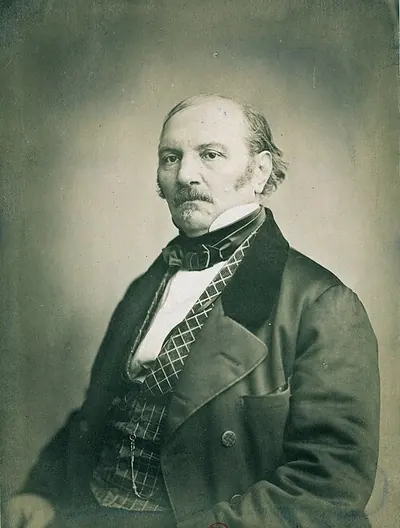
Who Is Allan Kardec
Allan Kardec (1804–1869), born Hippolyte Léon Denizard Rivail, was a French educator, philosopher, and writer who codified what became known as Spiritism—a philosophical and ethical system built on the premise that human beings are immortal spirits who undergo multiple incarnations for purposes of moral and intellectual evolution. A respected pedagogue before his involvement with mediumistic phenomena, Rivail adopted the pen name Allan Kardec and applied rigorous analytical methods to the investigation of spirit communications, compiling the results into a series of foundational texts that have had enormous cultural impact, particularly in Brazil.
Kardec’s relevance to IMHU’s mission may not be immediately obvious to readers from North American or European secular contexts, but in Brazil—one of the world’s largest and most dynamic mental health cultures—Spiritism is a major force. Spiritist psychiatric hospitals and clinics operate throughout the country, integrating prayer, mediumistic counseling, and energy healing (known as passes) with conventional psychiatric treatment. Researchers like Alexander Moreira-Almeida and Emma Bragdon have documented these integrative models, and IMHU has featured Spiritist approaches extensively. Understanding Kardec is essential for understanding this tradition, because virtually all Spiritist practice in Brazil traces back to his codification.
Core Concepts
- Reincarnation as moral evolution: Kardec’s central teaching is that the spirit is immortal and progresses through successive incarnations, each offering opportunities for learning, growth, and the refinement of character. Suffering is understood not as punishment but as a consequence of past choices and an opportunity for development. This framework provides a meaning-making structure for people experiencing mental distress—though it must be applied carefully, as it can also be misused to spiritually bypass genuine clinical needs.
- Mediumship as a natural human faculty: Kardec argued that mediumship—the capacity to perceive or communicate with discarnate spirits—is a natural ability that varies across individuals and can be developed through practice and moral cultivation. He distinguished carefully between different types and qualities of mediumistic phenomena. This framework is clinically relevant because it offers a non-pathologizing interpretation of experiences (hearing voices, sensing presences, trance states) that in other contexts might be immediately diagnosed as psychotic symptoms.
- The spirit-body relationship and the perispirit: Kardec described a “perispirit” or semi-material envelope connecting the spirit to the physical body—essentially an energy body that mediates between consciousness and matter. This concept parallels the subtle body descriptions found in Hindu, Buddhist, and Taoist traditions and provides a theoretical basis for energy healing practices like the Spiritist passes (laying on of hands) used in Brazilian Spiritist centers.
- Obsession and spiritual influence on mental health: Kardec described a spectrum of negative spiritual influence ranging from simple “obsession” (persistent negative influence from a discarnate spirit) through “fascination” (where the influenced person is deceived about the nature of the influence) to “subjugation” (complete domination of the person’s will). Brazilian Spiritist psychiatrists use this framework alongside conventional diagnosis, sometimes identifying cases where spiritual factors appear to contribute to or complicate mental illness.
- Charity and moral reform as spiritual practice: Kardec insisted that genuine spiritual development requires moral action—charity, service, humility, and the progressive overcoming of selfishness. Spiritist centers throughout Brazil operate extensive charitable programs (hospitals, soup kitchens, educational services) based on this principle. This integration of spiritual practice with concrete service distinguishes Spiritism from more purely contemplative traditions.
Essential Writings
- The Spirits’ Book (Le Livre des Esprits, 1857): The foundational text of Spiritism, organized as a series of questions posed by Kardec and answered (he claimed) by spirit communicators through various mediums. It covers the nature of God, the spirit world, reincarnation, moral law, and the purpose of suffering. Best use: the primary source for understanding Spiritist philosophy—dense but systematic.
- The Mediums’ Book (Le Livre des Médiums, 1861): A practical manual on mediumship, including guidelines for identifying and developing mediumistic faculties, assessing the quality of spirit communications, and avoiding common pitfalls. Best use: essential for anyone wanting to understand how Spiritist practice actually works in clinical and community settings.
- The Gospel According to Spiritism (L’Évangile selon le Spiritisme, 1864): Kardec’s ethical treatise, reinterpreting the moral teachings of Jesus through a Spiritist lens and emphasizing charity, forgiveness, and progressive moral development. Best use: the key text for understanding the ethical framework that drives Spiritist charitable and therapeutic institutions.
- Heaven and Hell (Le Ciel et l’Enfer, 1865): An examination of the afterlife, divine justice, and the nature of suffering across incarnations. Best use: for readers interested in how Spiritism addresses questions of theodicy and the meaning of suffering—directly relevant to clients grappling with existential and spiritual distress.