


Summary
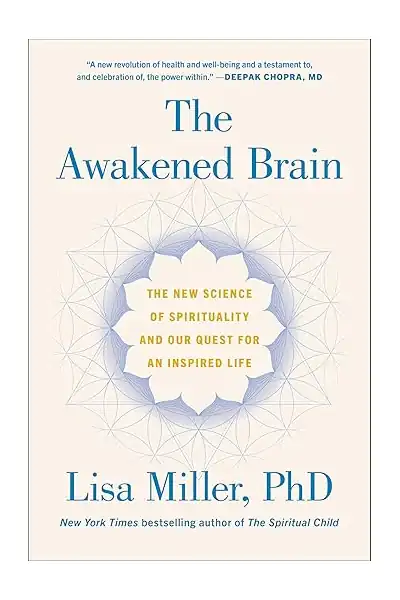
In "The Awakened Brain," Lisa Miller accomplishes something the field of psychology has needed for decades: she presents rigorous, peer-reviewed neuroscience demonstrating that the human brain is built for spiritual experience, and that engaging this capacity is one of the most powerful things we can do for our mental health. Miller, a clinical psychologist and professor at Columbia University's Teachers College, has spent over twenty-five years conducting and publishing research on the relationship between spirituality and psychological wellbeing. The evidence she's assembled is striking: people with an active spiritual life show dramatically lower rates of depression, substance abuse, and risk-taking behavior, and the protective effect of spirituality is visible in the structure and function of the brain itself.
What makes this book particularly compelling is Miller's willingness to go beyond the data and share her own spiritual journey alongside the science. She writes about the mystical experiences that shaped her life—moments of profound connection, guidance, and knowing that didn't fit the secular scientific worldview she was trained in but that she couldn't honestly dismiss. This combination of personal narrative and scientific evidence gives the book an unusual authenticity. Miller isn't a detached researcher reporting findings about other people's experiences. She's someone who has lived what she studies, and who has spent her career building the scientific case for something she knows from the inside. For IMHU's community, this book provides perhaps the strongest neuroscientific argument available for treating spiritual experience as a fundamental dimension of mental health rather than an irrelevant personal preference.
The Neuroscience of Spiritual Awareness
Miller's most headline-grabbing finding is that spirituality has a measurable effect on brain structure. Using MRI brain imaging, her research team found that people who reported a high importance of spirituality or religion in their lives showed thicker cortices in precisely the brain regions that thin in depression. This wasn't a subtle difference. The cortical thickening associated with spiritual life was substantial and appeared to be specifically protective against the development of depressive illness. People at high familial risk for depression who maintained an active spiritual life showed brain structures that looked fundamentally different from high-risk individuals without spiritual engagement.
This finding is significant because it suggests that spirituality isn't just a coping mechanism or a pleasant subjective experience. It's associated with physical changes in the brain that confer real protection against one of the most prevalent and debilitating mental health conditions in the world. Miller describes what she calls the "awakened brain"—a mode of neural functioning characterized by heightened connectivity, expanded perception, and a sense of being held within a larger reality. Her research suggests this isn't a rare state reserved for mystics and contemplatives. It's a natural capacity that all human brains possess, a built-in orientation toward connection and meaning that can be cultivated or neglected. When it's cultivated, through spiritual practice, contemplation, or simply a lived sense of connection to something larger than oneself, the brain literally changes in ways that support resilience and wellbeing.
The Achieving Brain Versus the Awakened Brain
Miller draws a crucial distinction between two modes of brain functioning that she calls the "achieving brain" and the "awakened brain." The achieving brain is the mode most of us operate in most of the time—focused, goal-directed, evaluative, oriented toward control and accomplishment. It's the brain state that modern education, professional training, and cultural values overwhelmingly cultivate. The awakened brain is something different: an expanded mode of awareness characterized by openness, receptivity, connection, and a sense of being guided or held by something beyond the individual ego. Both modes are valuable, but Miller argues that modern culture has become so lopsided in its emphasis on achieving that many people have essentially lost access to the awakened mode.
This imbalance has consequences. The achieving brain, operating without the balancing influence of the awakened brain, tends toward anxiety, depression, addiction, and a grinding sense of never-enough-ness. It's the mental posture of someone constantly striving, evaluating, and controlling—and it's exhausting. The awakened brain provides what the achieving brain cannot: a felt sense of being connected to life, of being part of something meaningful, of being held by a reality that's fundamentally supportive even when circumstances are difficult. Miller's research suggests that the epidemic of depression, anxiety, and meaninglessness in affluent societies may be substantially related to the systematic underdevelopment of this awakened capacity. We've built cultures that brilliantly train the achieving brain while starving the awakened brain of the experiences it needs to develop—and then we're surprised when people feel empty, anxious, and disconnected.
Spirituality as Protection Against Depression
The longitudinal research Miller presents on spirituality and depression is among the most compelling in the field. Following families over multiple generations, her studies found that personal spirituality—defined as a felt sense of connection to something transcendent, not mere religious attendance—reduced the risk of major depression by a remarkable degree, even among people with high genetic vulnerability. Children raised by depressed parents who developed their own spiritual lives showed dramatically better mental health outcomes than those who didn't. The protective effect was specific to personal spiritual experience rather than to religiosity per se—meaning it wasn't about going to church or following rules but about having a genuine felt relationship with a transcendent dimension of life.
This distinction between personal spiritual experience and institutional religious participation matters enormously. It means the protective benefits of spirituality aren't confined to people who identify with any particular tradition or institution. An atheist who experiences profound awe in nature, a secular meditator who cultivates a sense of interconnection, a person who feels guided by an intuitive wisdom they can't name—all of these may be engaging the same brain-based spiritual capacity that Miller's research shows is protective. This has major implications for clinical practice. If spirituality is genuinely protective against depression—one of the leading causes of disability worldwide—then helping clients develop their spiritual awareness isn't optional pastoral care. It's evidence-based prevention and treatment that any responsible clinician should know about and be prepared to support.
Spiritual Experience in Everyday Life
One of Miller's most valuable contributions is her insistence that the awakened brain isn't activated only during dramatic mystical experiences or formal spiritual practice. It's accessible in ordinary moments of everyday life—in the sudden recognition of a meaningful coincidence, in the feeling of being guided to the right place at the right time, in the experience of love that seems to come from beyond the personal self, in the quiet knowing that arrives when the striving mind finally rests. Miller calls these experiences "quests and arrivals" and suggests they're far more common than most people realize, precisely because our culture lacks frameworks for recognizing and valuing them.
This normalization of spiritual experience is critically important for IMHU's mission. Many people who have spontaneous spiritual experiences—synchronicities, intuitions, moments of transcendent connection, encounters with what feels like a guiding intelligence—keep them private because they fear being judged as irrational or mentally unstable. Miller's research provides scientific legitimacy for these experiences, demonstrating that they're associated with healthy brain functioning rather than pathology. The person who says "I felt guided" or "I knew something I couldn't have known" or "I felt held by something larger" isn't describing a delusion. They may be describing the natural functioning of a brain operating in its awakened mode—a mode that our culture has forgotten how to recognize and our clinical systems have been trained to ignore or pathologize.
Implications for Mental Health Care
Miller's work carries direct and urgent implications for how we approach mental health prevention and treatment. If the awakened brain is a natural human capacity that protects against depression and promotes resilience, then any mental health system that ignores or suppresses this capacity is actively working against its clients' wellbeing. This indictment applies to much of contemporary psychiatric and psychological practice, which has been structured around the achieving brain's values—identifying problems, setting goals, measuring progress, managing symptoms—while neglecting the awakened brain's contributions to healing: meaning, connection, surrender, trust, and openness to guidance beyond the individual ego.
Miller advocates for integrating spiritual awareness into clinical training and practice, not as an alternative to evidence-based approaches but as an evidence-based approach in its own right. She envisions mental health care that helps people develop their spiritual capacities alongside their coping skills, that recognizes depression not just as a chemical imbalance but as a potential signal that the awakened brain is being neglected, and that treats spiritual experiences as clinically relevant data rather than private beliefs to be politely ignored. For IMHU, Miller's work represents something close to a smoking gun: hard neuroscience from a major research university demonstrating that spiritual life literally changes the brain in ways that protect mental health. The implication is clear—a mental health system that excludes spirituality isn't just philosophically narrow. It's leaving one of the most powerful tools for human wellbeing sitting unused on the table, and people are suffering unnecessarily as a result.