


Summary
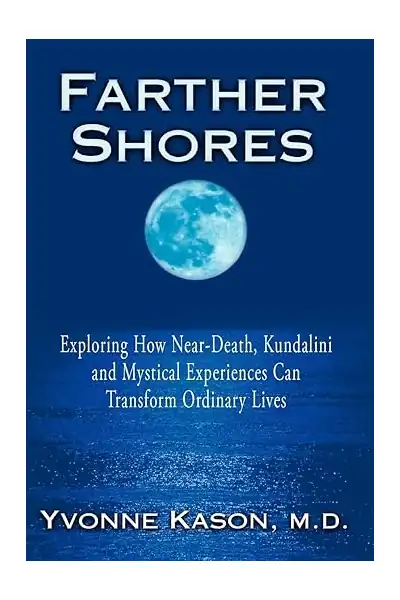
In "Farther Shores," Yvonne Kason writes from the extraordinary position of being both a physician-researcher who has studied transformative experiences for decades and a person who has lived through them. Her own near-death experience during a plane crash into a frozen lake catalyzed a lifelong investigation into the range of experiences she calls Spiritually Transformative Experiences (STEs)—a category that encompasses near-death experiences, kundalini awakenings, mystical experiences, psychic openings, and other non-ordinary states that permanently alter a person's understanding of themselves and reality. Kason, a Canadian family physician and researcher, coined the term STE specifically to provide a non-pathologizing clinical label for experiences that the medical system had no adequate language to describe.
What makes this book particularly valuable for IMHU's community is Kason's integration of clinical competence, personal experience, and genuine respect for the transformative potential of these states. She doesn't approach STEs as a detached researcher cataloguing exotic phenomena. She approaches them as a clinician who has been through the territory herself, who has treated hundreds of patients navigating similar experiences, and who has seen firsthand both the extraordinary gifts and the genuine dangers these experiences can bring. The result is a book that provides practical, clinically grounded guidance for people going through STEs and for the professionals trying to help them—guidance that neither pathologizes the experience nor minimizes its challenges.
Mapping Spiritually Transformative Experiences
Kason's first major contribution is taxonomic: she creates a comprehensive map of the different types of Spiritually Transformative Experiences, identifying their common features and distinguishing characteristics. Near-death experiences involve perception during clinical death or near-death conditions, often including the classic elements of tunnel, light, life review, and encounter with deceased beings or spiritual presences. Kundalini awakenings involve the activation of a powerful psycho-spiritual energy that produces physical symptoms, altered perception, emotional upheaval, and potentially profound spiritual insight. Mystical experiences involve direct apprehension of a transcendent reality characterized by unity, profound peace, and noetic certainty. Psychic openings involve the sudden onset of extrasensory perception, clairvoyance, or other non-ordinary cognitive capacities.
By mapping these experiences as related phenomena rather than treating each in isolation, Kason reveals patterns that no single-phenomenon approach would catch. She observes that people who have one type of STE are more likely to have others. That the aftereffects of different types of STEs share common features: increased sensitivity, expanded awareness, altered values, difficulty fitting back into conventional life. That the integration challenges are similar across types, and that the clinical needs of people navigating these experiences overlap significantly regardless of the specific form the experience takes. This unified mapping gives clinicians a framework for recognizing and responding to the full range of STEs rather than knowing about near-death experiences but being blind to kundalini awakenings, or understanding mystical experience but missing psychic openings.
The Kundalini Process
Kason devotes particular attention to kundalini awakening—a phenomenon she considers both the most clinically challenging and the most frequently misdiagnosed of all STEs. The kundalini process, as she describes it drawing on both Yogic tradition and clinical observation, involves the activation of a powerful transformative energy that can produce an extraordinary range of physical, emotional, and perceptual symptoms: involuntary body movements, sensations of heat or energy moving through the body, altered breathing patterns, emotional upheaval, perceptual changes including visions and inner sounds, and states of consciousness that range from blissful to terrifying. When this process is gradual and well-supported, it can lead to expanded consciousness and profound spiritual development. When it's sudden, overwhelming, or unsupported, it can produce a crisis that looks alarmingly like psychosis.
The clinical importance of understanding kundalini cannot be overstated. A person in the midst of a kundalini crisis who presents at an emergency department will typically be assessed for psychosis, medicated with antipsychotics, and possibly hospitalized—interventions that may suppress the process without resolving it, creating a pattern of recurring crises and escalating medication. A clinician who understands kundalini can recognize the distinctive features—the energy sensations, the involuntary movements, the retention of insight and self-reflection even during intense symptoms—and respond with appropriate support rather than suppression. Kason provides detailed clinical guidance for distinguishing kundalini processes from psychotic episodes and for supporting people through the acute and ongoing phases of the awakening. This guidance alone makes the book an essential clinical resource.
Aftereffects and Integration Challenges
Kason documents in detail the aftereffects that commonly follow STEs—changes that are often as challenging as the initial experience and that receive even less clinical attention. People who have had profound STEs frequently report permanent changes in their values, relationships, and sense of identity. They may lose interest in material pursuits that previously motivated them. Their relationships may become strained as partners and friends struggle to understand their transformation. They may develop heightened sensitivity to stimulation, electromagnetic fields, and the emotional states of others. They may find that their previous career no longer feels meaningful. They may struggle to communicate what happened to them in language that others can understand.
These aftereffects aren't pathological. They're natural consequences of a profound shift in consciousness—the challenge of living in a world organized around ordinary consciousness after one has directly experienced something that transcends it. But they create real practical difficulties that need real practical support. Kason emphasizes that integration—the process of incorporating the insights and changes catalyzed by an STE into one's ongoing life—is not a brief aftermath but an extended process that can take months or years. People need ongoing support during this period: someone who understands what they've been through, practical strategies for managing heightened sensitivity, guidance for navigating relationship changes, and frameworks for making meaning of an experience that may have shattered their previous worldview. The absence of this support is one of the primary reasons STEs become problematic rather than transformative.
Clinical Guidelines for Professionals
Among the book's most practically useful sections are Kason's specific clinical guidelines for professionals working with people who are having or have had STEs. She provides criteria for distinguishing STEs from psychotic episodes, emphasizing features like the retention of insight and self-reflection, the coherent narrative quality of the experience, the absence of thought disorder, and the transformative rather than deteriorative trajectory. She offers guidance on when medication is and isn't appropriate—acknowledging that sometimes pharmacological intervention is necessary for safety while cautioning against the reflexive use of antipsychotics that may suppress a process that needs to unfold rather than be shut down.
Kason also addresses the therapeutic stance that professionals should bring to this work. She advocates for genuine openness to the possibility that STEs represent contact with dimensions of reality beyond the materialist paradigm, while maintaining the clinical competence to recognize when a person needs medical intervention. This isn't an easy balance, and she's honest about the challenges. But she insists that clinicians who dismiss their patients' STEs as pathological are causing harm—invalidating experiences that may be among the most significant events of their patients' lives and missing opportunities to support genuine transformation. For IMHU, these clinical guidelines provide exactly the kind of practical, grounded, professionally credible guidance that clinicians need to navigate this territory responsibly.
A Personal and Professional Legacy
What gives "Farther Shores" its distinctive power is Kason's willingness to integrate her personal experience with her professional expertise. She writes openly about her own near-death experience, her subsequent kundalini awakening, and the years of integration challenges she navigated while maintaining a medical practice and raising a family. This personal transparency accomplishes something that purely clinical or purely spiritual accounts cannot: it demonstrates that these experiences happen to real, functional, professionally accomplished people, and that the challenge of integrating them is not a sign of weakness but a natural consequence of the experience's depth and power.
Kason's personal journey also illustrates the cost of working in this field within mainstream medical culture. Like John Mack at Harvard, she faced professional skepticism and institutional resistance for taking her patients' spiritual experiences seriously. Her persistence despite this resistance—and her ability to build a body of clinical work and published research over decades—demonstrates the kind of sustained courage that expanding clinical frameworks requires. For IMHU, Kason's work represents a model for what's possible when a clinician brings both professional rigor and personal authenticity to the encounter with transformative experience. "Farther Shores" remains one of the most practically useful and humanly honest books available for anyone navigating the territory where medicine, psychology, and spiritual transformation intersect.