


Summary
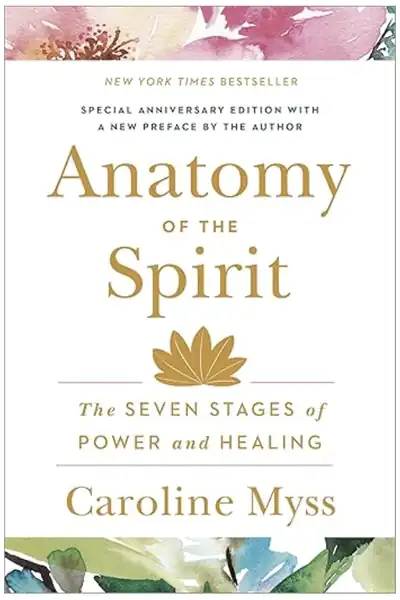
In "Anatomy of the Spirit," Caroline Myss presents one of the most ambitious synthesis projects in the literature of healing and consciousness: a unified model that maps the human energy system by weaving together three ancient traditions—the Hindu chakras, the Christian sacraments, and the Kabbalistic Tree of Life. Her central claim is that these three systems, developed independently across vastly different cultures and centuries, describe the same underlying architecture of human spiritual development. Each tradition identified seven stages of power through which human beings grow, suffer, heal, and ultimately transform. That three separate wisdom lineages converged on the same sevenfold map suggests they were observing something real about the structure of consciousness and its relationship to the body.
Myss writes from an unusual vantage point. She spent years working as a medical intuitive alongside physicians, learning to perceive the energetic patterns associated with illness often before physical symptoms appeared. This experience convinced her that disease is rarely random. It follows predictable patterns connected to unresolved emotional, psychological, and spiritual issues that correspond to specific energy centers in the body. "Anatomy of the Spirit" is her attempt to make this understanding accessible and practical, offering a framework for understanding how personal history, emotional patterns, and spiritual challenges manifest in the body and how conscious engagement with these patterns can support healing. For IMHU's community, this book provides a sophisticated bridge between spiritual wisdom traditions and the lived experience of illness and healing—territory that mainstream medicine barely acknowledges but that millions of people navigate every day.
Three Traditions, One Map
The book's foundational insight is the convergence of three seemingly unrelated spiritual systems around the same seven-stage model of human development. The Hindu chakra system maps seven energy centers running from the base of the spine to the crown of the head, each governing specific physical, emotional, and spiritual functions. The seven Christian sacraments—Baptism, Communion, Confirmation, Marriage, Confession, Ordination, and Extreme Unction—mark stages of spiritual maturation that correspond to these same energy centers. The ten sefirot of the Kabbalistic Tree of Life, when grouped into seven levels, describe the same developmental progression from primal survival to divine union.
Myss argues that this convergence isn't coincidental. These traditions were each mapping the same territory—the progressive unfolding of human consciousness from its most basic survival concerns through increasingly complex emotional, relational, and spiritual challenges toward its fullest expression. The first chakra deals with tribal power and belonging, corresponding to the sacrament of Baptism and the Kabbalistic concept of Shekhinah. The fourth addresses love, forgiveness, and emotional openness, corresponding to Marriage and Tif'eret. The seventh concerns spiritual connection and life purpose, corresponding to Extreme Unction and Keter. Whether or not one accepts that these traditions are describing an objective energetic anatomy, the cross-cultural resonance is striking and suggests that certain patterns of human spiritual development may be universal—not the product of any one culture's imagination but observations of something inherent in what it means to be human.
Biography Becomes Biology
Perhaps Myss's most provocative and widely cited claim is captured in her phrase "your biography becomes your biology." She argues that the experiences, beliefs, attitudes, and unresolved emotional wounds we carry don't just affect our psychological wellbeing. They become encoded in our physical bodies, creating patterns of energetic dysfunction that can eventually manifest as illness. A person who has experienced profound betrayal may develop heart disease. Someone who has suppressed their authentic voice for decades may develop thyroid problems. A person who has never felt safe in the world may be vulnerable to disorders of the immune system.
This isn't a simplistic claim that bad thoughts cause cancer. Myss is careful to acknowledge that disease has multiple causes and that genetic, environmental, and random factors play real roles. What she's proposing is that emotional and spiritual patterns create vulnerabilities—areas of energetic weakness where illness is more likely to take hold. The mechanism she describes isn't magical but informational: unresolved emotional energy disrupts the flow of life force through the body's energy system, creating conditions that over time can compromise physical health. This framework gives people something that purely biomedical models don't: a way to understand their illness as meaningful, connected to their life story, and potentially responsive to inner work as well as medical treatment. It doesn't replace conventional medicine, but it adds a dimension that many patients intuitively feel is missing from their care—the sense that their body is trying to tell them something, and that healing involves listening.
Power and Its Misuses
Running through the seven-stage model is a sustained meditation on the nature of personal power—how we gain it, lose it, give it away, and learn to use it wisely. Myss defines power not as dominance over others but as the capacity to direct one's own life force with conscious intention. Each energy center represents a different arena in which power must be developed and can be lost. At the first chakra, the challenge is to develop enough independence to think and act beyond the dictates of tribal or family conditioning. At the third, the challenge is to cultivate self-esteem and personal integrity without becoming narcissistic. At the fifth, the challenge is to speak and live one's truth even when it's costly.
Myss argues that illness often develops in the energy center associated with a particular power struggle the person hasn't resolved. Someone locked in a battle for control in their intimate relationships may develop illness in the second chakra region—reproductive organs, lower back, bladder. Someone who has repeatedly betrayed their own integrity to please others may develop third chakra disorders—stomach problems, diabetes, liver dysfunction. This framework offers a remarkably specific way to explore the relationship between psychological patterns and physical vulnerability. Whether one interprets this energetically or metaphorically, it provides a clinical tool for helping people examine the connections between their unresolved life challenges and their physical symptoms—connections that mainstream medicine almost never explores but that many patients sense intuitively.
Healing as Spiritual Practice
Myss is unequivocal that genuine healing is a spiritual process, not merely a physical one. This doesn't mean prayer replaces surgery or that spiritual awareness guarantees physical cure. It means that the deepest healing—the kind that transforms a person's relationship with themselves, their history, and their life—requires engaging with the spiritual dimensions of illness. A person can recover physically from cancer through surgery and chemotherapy without ever addressing the energetic and emotional patterns that contributed to the disease. They may survive, but they haven't healed in the fullest sense. True healing, in Myss's framework, involves becoming conscious of the patterns that created vulnerability and choosing to transform them.
This perspective has practical implications for how people approach their health challenges. It means that illness, while never welcome, can serve as an invitation to deeper self-knowledge and spiritual growth. The questions Myss encourages people to ask—Where am I losing power? What am I refusing to face? What unresolved emotional material am I carrying in my body?—are fundamentally spiritual questions even when they're applied to physical conditions. They assume that human beings are more than biological machines, that consciousness plays a role in health and illness, and that the body's wisdom extends beyond what medical tests can measure. For IMHU's community, this approach to healing provides a framework that honors both the physical reality of illness and the spiritual dimensions that mainstream medicine tends to dismiss. It insists that we are whole beings—body, mind, and spirit—and that healing that addresses only one dimension will always be incomplete.
Limitations and Lasting Contributions
It's worth acknowledging that Myss's work has drawn criticism, some of it legitimate. The claim that specific emotional patterns produce specific diseases can shade into victim-blaming if handled carelessly, and some readers have felt burdened by the implication that their illness reflects a spiritual failure. Myss herself has addressed this concern, insisting that the framework is meant to empower rather than shame, but the risk remains. The scientific evidence for the specific chakra-organ-emotion correspondences she describes is largely anecdotal rather than experimentally validated. And the synthesis of three wisdom traditions, while intellectually stimulating, involves simplifications and interpretive choices that scholars of any single tradition might challenge.
These limitations acknowledged, the book's lasting contribution is significant. Myss helped bring the concept of energy anatomy into mainstream awareness at a time when most people had never heard of chakras. She articulated a framework that gave millions of people a way to understand the connection between their emotional lives and their physical health—a connection they felt intuitively but couldn't articulate within the vocabulary of conventional medicine. She modeled the kind of cross-traditional synthesis that IMHU values, demonstrating that different wisdom traditions can illuminate each other without being reduced to each other. And she insisted, with considerable force and clarity, that human beings cannot be understood or healed as purely physical organisms. The body speaks the language of the spirit, and learning to listen to that language is essential for anyone serious about health, healing, and the full development of human potential.