


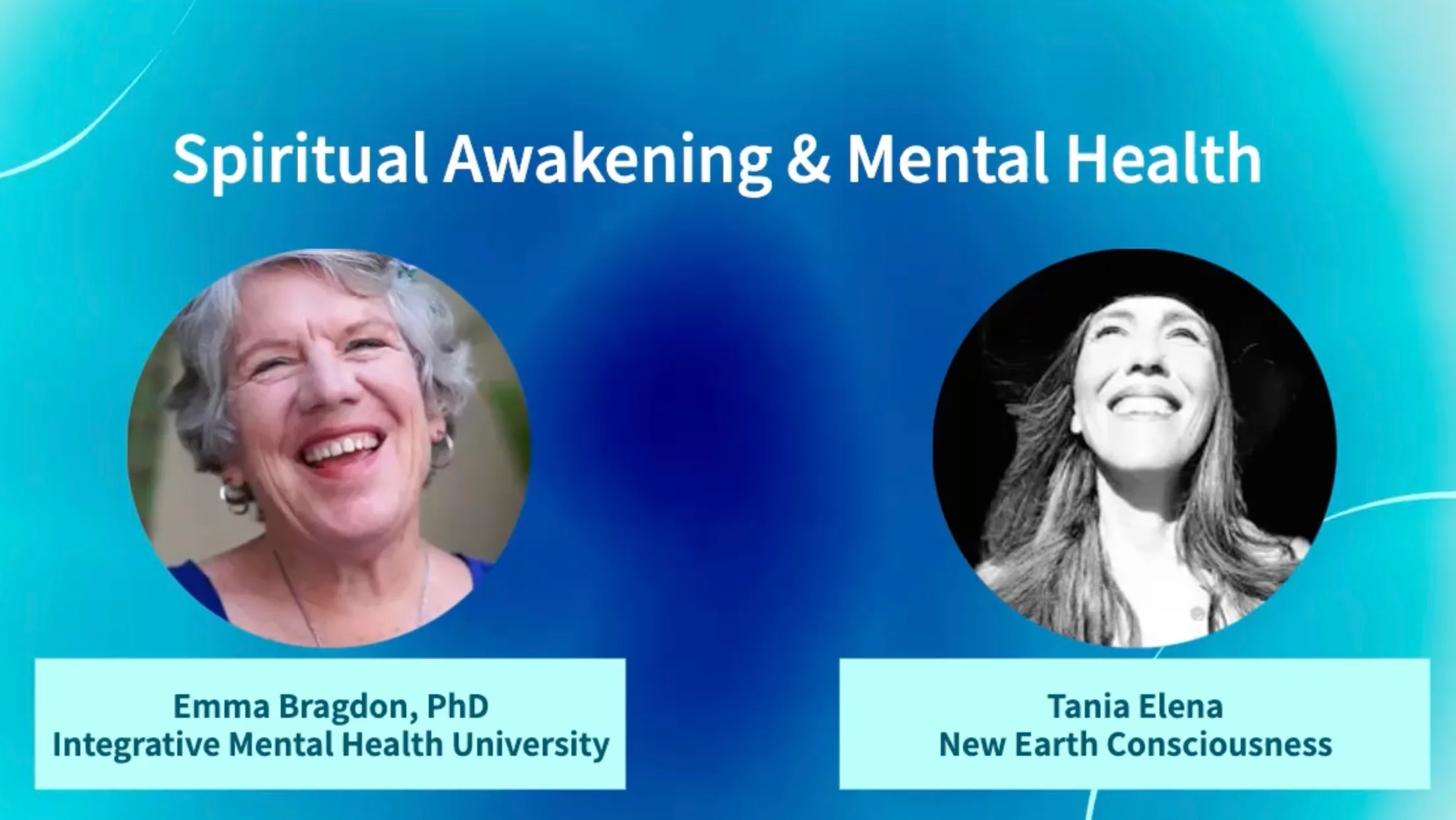
Awakening and Mental Health
Summary
Tanya from New Earth Consciousness interviews Emma Bragdon, founder of Integrative Mental Health University and author of seven books, about spiritual awakening, spiritual emergency, and integration. Bragdon shares how two childhood near-death experiences led her to meditation, Zen practice, shamanic training with Yurok and Lakota teachers, and a PhD in transpersonal psychology. She describes work in Brazil observing Spiritist healing, psychiatric hospitals, and community centers that support distressed awakenings without labeling people psychotic, influencing her efforts to improve U.S. mental healthcare. She explains Spiritism’s origins and how it differs from Spiritualism, and emphasizes that awakening and psychological distress can co-occur, especially when trauma surfaces. She links rising awakenings to a cultural shift toward energy as primary, discusses risks and benefits of heightened sensitivity and psychedelics, and outlines best practices for preparation and post-journey integration. She highlights IMHU’s online training, an international directory of 140 spiritual emergence coaches (IMHU.org), and her consultation practice (emmabragdon.com).
Spiritual awakening and psychological distress can overlap
One of Emma’s most important points is that spiritual awakening and mental health struggle are not always separate categories. She rejects the simplistic idea that a person is either having a spiritual experience or suffering from pathology. Instead, she explains that powerful openings can occur alongside trauma, anxiety, depression, nightmares, confusion, or emotional instability, especially when old wounds are stirred up by the awakening process. Her example of a child seeing Christ during a traumatic event shows how a deeply spiritual experience can coexist with acute distress. The broader point is that these situations require nuance, not reductionism.
Brazil offers a different model of care
Emma describes how her work in Brazil exposed her to Spiritist hospitals and community centers that support people in spiritual crisis without automatically labeling them psychotic. In those settings, distressed individuals may be understood as highly sensitive people going through a profound transformation rather than as disordered patients needing suppression. This deeply influenced Emma’s mission to improve the U.S. mental healthcare system. She also distinguishes Spiritism from Spiritualism, emphasizing that Spiritism is more serious and development-oriented, with a focus on spiritual growth rather than fascination with paranormal phenomena.
Rising awakenings reflect a shift in consciousness
Emma offers a broader explanation for why more people seem to be having spiritual experiences now. Drawing on the Indian concept of the Yugas, she argues that humanity is moving out of a materialist age and into an era in which energy is increasingly recognized as more fundamental than matter. In her view, this shift helps explain why more people are becoming sensitive to subtle energies, intuition, clairaudience, healing, and other nonordinary experiences. She also notes that psychedelics and plant medicines are accelerating this opening for many people, though often without adequate guidance. The implication is that these experiences are not random anomalies but part of a larger cultural and spiritual transition.
Integration turns awakening into human flourishing
A central theme of the conversation is that spiritual experience alone is not enough; what matters is whether it is integrated. Emma contrasts casual psychedelic use pursued like entertainment with intentional work that includes preparation, skilled guidance, and follow-up integration. She argues that when people receive proper support, spiritual experiences often lead to greater peace, happiness, connection, and a desire to serve others. Without support, the same experiences can feel destabilizing and isolating. Her larger vision is that mental healthcare should move beyond diagnosis and symptom control toward helping people flourish, especially when spiritual emergence is part of the picture.